


Ireland’s Olympics: The Tailteann Games
Written by Ciaran on July 09, 2025 | 0 Comments
Summer is a time for sport in Ireland. These days we have the All Ireland finals where teams battle it out for the right to represent their county at Croke Park in Dublin.

A shot from the crowd at the All Ireland Hurling final in Croke Park.
Photo Credit: Brendan Rankin (CC BY-NC-ND 2.0)
And it seems summer has always been for sport! These epic battles echo what went before, in the Tailteann Games. Some may know these games as "Ireland’s Olympics." This was an annual event, perhaps a little older and certainly longer than their Greek counterpart. Definitely with fewer togas and olive wreaths! Read on to find out more about this curious competition.

Front cover of a promotional pamphlet for the Tailteann Games
Photo Credit: Royal Irish Academy Library
When and where did the Tailteann Games start?
Legend holds that the Tailteann Games were established in 1829 BC, while folklore suggests a start date of 1600 BC. These dates would make them at least 1000 years older than the Greek games.
There are later Iron age archeological features, including forts, a roadway, and artificial lakes at the site where the games were said to be held. So there does seem to be some case for saying the Tailteann games are ancient. And if not older than the Olympics, certainly contemporaries!

The mound of Rathdhú in Teltown, Tailteann in Irish, in present day Co. Meath, thought to be one of the main sites of activity in the games.
Photo Credit: Howard Goldbaum (CC BY-NC 4.0)
Though sources don’t agree on the start date, all are in agreement that it was the god Lugh who kicked things off! Also known as Lugh Samildánach, Lugh of Many Talents, this warrior, king, and master of arts and crafts also seems to have also been a model stepson. He reportedly held the first games in the last two weeks of July in honor of his late foster-mother, Tailtiu.
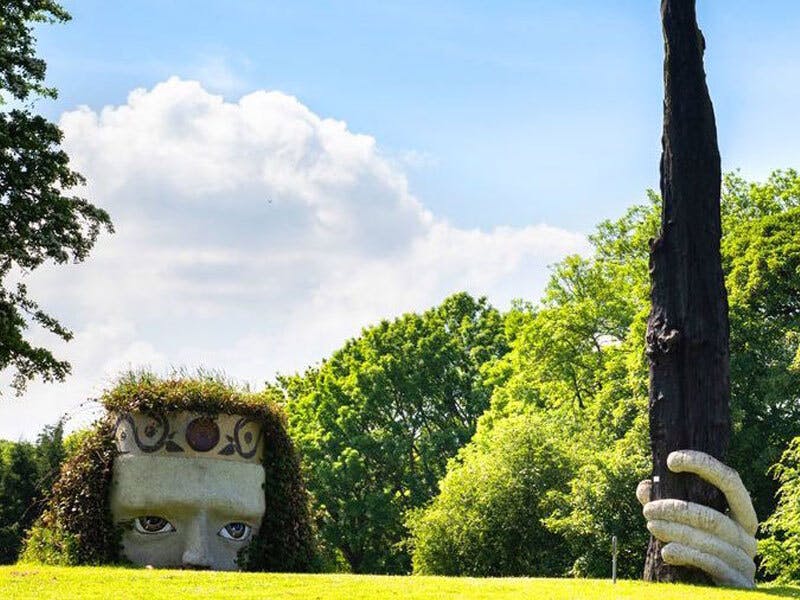
Tailtiu, had perished from exhaustion after clearing the plains of Ireland, so that people could plant crops. She was buried where she fell, on the plains of present day Co. Meath, with a dying wish to have a gathering and games in her honor. Now funeral games may not sound like a crowd pleaser, but we Irish have always had an interesting approach to mourning. We like to throw a proper send-off!
What did the Tailteann Games entail?
That link to a funeral might give you pause, but the mention of the Olympics surely conjures visions of all manner of athletic pursuits. The Comórtais, or competitions, certainly did include all manner of physical feats and tests of strength. Lugh himself was said to have competed in some of these, though perhaps that was a little unfair given he was a god!

An illustration of Setanta, the demi-god son of Lugh, who grew up to be Culainn or Cú Cuhulain, a near unbeatable warrior himself.
Photo Credit: Public Domain
The physical games included all manner of skills prized in a warrior. There was archery, running, long jump, high jump, spear throwing, wrestling, boxing, sword fighting, and swimming along with team sports like hurling, as well as chariot and horse racing!

Cuchulain all grown up and in warrior mode on his chariot in an illustration by J. C. Leyendecker in T. W. Rolleston's Myths & Legends of the Celtic Race, 1911.
Photo Credit: Public Domain
If that wasn’t enough to be getting on with, the games also included competitions for more artistic pursuits. There was singing, dancing, and story-telling. But also crafting competitions for goldsmiths, blacksmiths, weavers and even jewelers! Our chance to shine!

There were artistic pursuits in the Olympics of that era too. Ireland’s FIRST ever Olympic medal was a silver to Jack B Yeats in 1924 for a painting depicting another Irish sporting institution - The Liffey Swim!
And despite the involvement of so many metalworkers, there were no medals, gold or otherwise. Champions were congratulated and won not money, but honor and of course bragging rights for the coming year.
Love at the Games
Victors may have also won a few hearts. Being a celebration of life, vitality and plenty, there was unsurprisingly a bit of romance a the games too. These celebrations ran into those of Lúnasa, with trial marriages part of the event calendar. Young couples tried their marriage out for a year and a day. If it didn’t work out, they literally walked away from each other at the following year's games. High stakes indeed!
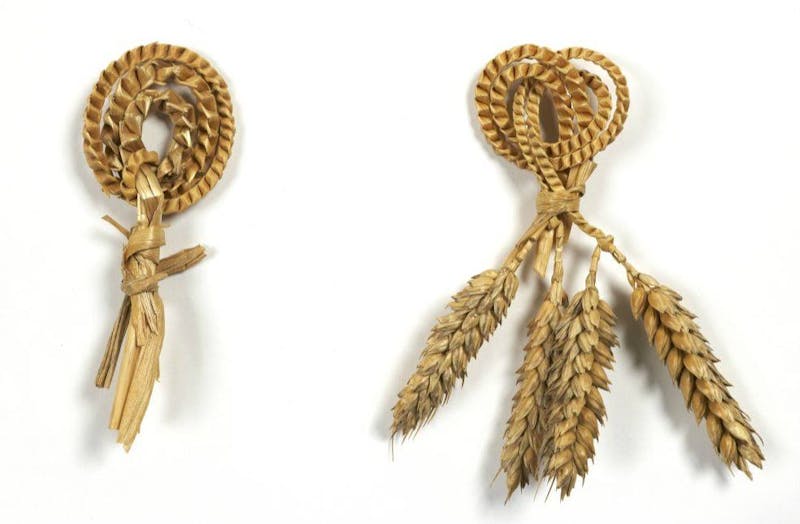
pair of harvest “love” knots given to love interests or lovers at Lúnasa festivals.
Photo Credit: National Museum of Ireland
When and why did the Tailteann Games stop?
Well for a very long time, they didn’t! The Annals of the Four Masters compiled in the 1600s note that the Tailteann Games were held yearly for centuries. This document even records a rare omission 873 AD, though sadly no reason for the missed games is made. This same record puts the last official games in the year 1168. It seems the games finished with a bang, with the mounted procession to the event said to cause a tailback of nearly 10 km! After this date there were unofficial games held here and there. The Norman invasions and general medieval messiness seems to have put an end to the practice.
Tailteann Games Take Two
The games did make a brief comeback in the 1920s. Who doesn’t love a good comeback tour? In a fit of patriotic ambition, the Irish Free state with the support of the Gaelic Athletic Association and others, organised Tailteann Games in 1924, and again in 1928. Held to coincide with the Olympics those same years, this event was conceived to put Ireland on the map and reignite a glorious past.

The fireworks display on August 15, 1924 in Croke Park for the first games.
Photo Credit: Public Domain National Library of Ireland on The Commons
Some things were different from the ancient games. For one they adopted the Olympic four year cycle. The venue had also shifted from Meath to Croke Park in Dublin, and the games were open to “any of Irish birth or ancestry.”

They may have made an exception on those eligibility criteria for Johnny Weissmuller in 1924 games! This superstar of Tarzan fame started his career as a world record setting swimmer, winning five gold medals in the Olympics and of course every race he entered in the 1924 Tailteann Games too!
Photo Credit: Public Domain
The events themselves were quite similar though. Competitors, including Hollywood’s Tarzan, Johnny Weissmuller, competed in many of the original events from hurling to singing, along with a few new ones including motor racing.
This event was a staggering feat for a small country that had been wracked by war. Over 6000 competitors took part in that first games in over 20 different categories. The 1928 games grew further, with over 30 categories, including the addition of handball, camogie, chess, boat racing, and architecture. However the third iteration of these revived games in 1932 was less successful. With serious funding deficits, the 1936 games never got off the ground.
And though it would be great to see the Tailteann Games still around today, many elements live on in the sporting events and colourful festivals around the country at this time of year.
Get In Touch
Have a question or something you're not entirely sure about when browsing our pieces? Please reach out. You can send us a note or give us a call—the Dublin workshop is here to make sure that you have a perfect experience from start to finish with My Irish Jeweler.
Follow us on Facebook and Instagram, to see what's new and upcoming. Join our Email list for early offers and special features.

Ciaran
My Irish Jeweler
Born in Co. Antrim and reared in Dublin, I was fascinated with Gaelic culture from an early age. I suppose it's not surprising given my mother inherited a grá for the Irish language from my grandfather, an Irish school headmaster. And that grá continues! My brother and sister are now Gaelic teachers here in Ireland, my niece is an award winning Irish dancer, and I proudly work to share Irish culture through our Irish and Celtic Jewelry at My Irish Jeweler!
I love researching and reading about the history of Irish design. It's at the core of what we do here at My Irish Jeweler. I find much of it so interesting that I have to share what I find. I hope you enjoy it!
Comments



 Ask Gemma