


St. Patrick's Day Countdown: Ireland and Potatoes
Written by Ciaran on Mar 01, 2026 | 0 Comments
Those with very good memories will remember we joked about Gemma’s potato obsession before Christmas. We all know it is a bit of a stereotype, but we have finally given in to Gemma’s calls for a blog series celebrating the humble spud.
Gemma being Gemma, she ambitiously wanted to share “50 Ways to Eat a Potato.” We are starting with just the 17 for now, one for each day of March in the lead up to one of our biggest celebrations of the year, St. Patrick’s Day.

We will be sharing recipies from the team for breakfast, lunch, and dinner that feature the humble spud.
Photo Credit: J. Chadwick
Ireland and Potatoes
Before we get to the recipes, what about that stereotype? We were curious to dig into that strong link between Ireland and the potato. How is a vegetable that only came to the island in the 17th century so closely associated with Ireland the world over?

The Potato Diggers by Paul Henry (1910-1911), an oil painting depicting the hard toil of potato harvesting on Achill Island in the early 20th Century, which sold for €400,000 in 2013.
Photo Credit: Adams
Early adopters
Firstly, it seems Ireland was an early adopter of the humble spud when it was brought from South America to Europe. It was the first European country to cultivate this “new” crop on a wide scale in the early 17th century. The enthusiastic, island-wide embrace of the potato led to the situation where, by 1809, Thomas Jefferson gave an Irish origin to the tubers growing in North America:
“in page 186. you say the potatoe is a native of the US. I presume you speak of the Irish potatoe. I have enquired much into this question, & think I can assure you that plant is not a native of N. America……. it is a native of Guiana; & Clavigero, that the Mexicans got it from S. America, it’s native country. the most probable account I have been able to collect is that a vessel of Sr Walter Raleigh’s, returning from Guiana, put into the West of Ireland in distress, having on board some potatoes which they called earth apples. that the season of the year, & circumstance of their being already sprouted induced them to give them all out there, and they were no more heard or thought of, till they had been spread considerably into that island, whence they were carried over into England, & therefore called the Irish potatoe.
Thomas Jefferson to Horatio G. Spafford, 14 May 1809.” Founders Online, National Archives.
A perfect match
The origin story put forward by Thomas Jefferson above may not be 100% accurate. Many contest the idea that it was Sir Walter Raleigh that first brought potatoes to Ireland at his Myrtle Grove residence.

A postcard of Myrtle Grove, Irish residence of Sir Walter Raleigh and ground zero for the potato if some historical records are to be believed.
The only issue is potatoes were known as An Spáinneach which means "The Spaniard" in Irish at this time. So perhaps spanish traders may have got there first!
Jefferson was certainly spot on when he asserted that the potato had spread across the island rapidly. But you may be wondering why the potato was so enthusiastically adopted in Ireland when it was viewed with suspicion elsewhere?
Rather than it being any one thing, there were several reasons why the potato was the perfect match for Ireland. It grew very well in the somewhat soggy Irish climate and suited the Irish soil. It was relatively low cost and produced more food per square meter than other crops of the day, making it economically attractive too. It could also be stored for long periods. These factors and more made it very attractive to Irish families, as they could feed their entire household quite well with a relatively small plot of land.

A man spreading seaweed on potato ridges in Connemara, Co. Galway in the early 20th century.
Photo Credit: Image and data © National Folklore Collection, UCD.
It’s said that by 1830, the average young Irish male was fueling up with 5kg of potatoes per day! By 1841, the island's population had doubled in just 50 years to 8.15 million, driven in part by this carbohydrate-rich diet. By 1845, one-third of all land capable of producing crops was being used to grow potatoes.
What happened next?
As you probably know, 1845 is a pivotal year in Irish history. It marks the beginning of the Great Famine, brought about by a blight that devastated potato crops and led to starvation and disease across the island. From 1845 to 1852 more than a million people died, and another million fled to Britain, North America, and Australia.

An incredible image by Bernd Thaller of The Famine Memorial sculpture by Dublin artist Rowan Gillespie. The haunting sculpture is located on Custom House Quay, at the departure site of the Perseverance, one of the first famine ships to leave Dublin in 1846.
Photo Credit: Image by Bernd Thaller (CC BY 2.0)
This calamitous event left lasting impacts on Ireland that are still felt to this day. The current population on the island is only now approaching pre-famine levels, over 180 years later. People emigrated in wave after wave, with another two million leaving in the decades after the famine. This had knock-on effects in the countries that received the fleeing emigrants, too. With more than a quarter of a million Irish-born residents, 1850’s New York was the most Irish city in the world, and to this day, the number of people of Irish descent worldwide dwarfs the population of the island itself.

A political cartoon from 1881 lamenting the migration of the Irish. John Johnson Collection of Printed Ephemera at the Bodleian Libraries, Oxford University.
No grudge held
Given the scale of the disaster, you might be forgiven for thinking that would be it for the potato in Ireland. But there was no grudge held against the potato as a major foodstuff on the island.
New national dishes like Dublin Coddle grew up from the newly urbanized population. And the potato remains at the centre of cherished national dishes right through to today, with notable new additions like the Spice Bag added to the canon in the 21st century, reflecting the changing tastes of modern Ireland.

A spice bag is a relatively recent addition to cherished national dishes here in Ireland, which made its way into the Oxford Dictionary in 2012. It may make an appearance later on in our series!
Photo Credit: Sean Zissou (CC BY 4.0)
And the potato's cultural footprint stretches still further. There are nearly 6,500 references to the potato in the Irish National Folklore Collection, indicating its cultural importance. The arts are also well stocked with potatoes! In Joyce's Ulysses the protagonist, Leopold Bloom, sets off on his Dublin odyssey with a potato in his pocket. Famously, the nation’s favourite poem, “When All The Others Were Away At Mass,” by Seamus Heaney, vividly depicts the memory of the author peeling potatoes with his mother.
Ireland and potatoes may be a stereotype, but it certainly has deep and broad roots!
Potato Recipe for Day 1: Potato Cakes for Breakfast
There isn’t a child in Ireland who hasn’t happily gobbled down potato cakes, for breakfast certainly, but also lunch, dinner or tea. Also known as potato bread, or farls, they are more like a pancake than anything else and are a great way to use up leftover spuds, which is probably the origin of the recipe to begin with!
My own kids give this recipe their most glowing recommendation. They tell their mam it can even be eaten without any ketchup - high praise indeed!
We eat this for special breakfasts like Christmas morning and St. Patrick’s Day, served with eggs and whatever else you fancy in your fry-up! Sausages and rashers (bacon) are traditional, and you can add tomato and mushrooms if you are feeling fancy. It will certainly set you up for a busy day of celebrations!

Photo Credit: J. Chadwick
This mix freezes really well and, once thawed, can be cooked as normal, so it can be made well ahead… though we have never had cause to hold any back! As I said, our kids are fans of this one. The other nice thing about this recipe is that once you keep the ratio around 4 parts potato to 1 part flour, you can make it in whatever quantity you like!
Jane tells me there is one caveat: if you are using leftover mash with milk in it, you may need to adjust the ratio a bit and add more flour to get the right consistency.
Ingredients
- 480 g cooked and finely mashed potato - Jane uses roosters, but you can use whatever you have
- 120 g Plain white flour.
- A pinch of black pepper (you can leave this out if you like; it is not traditional and borders on Notions, but it certainly does add a little extra to the end result!)
- A generous pinch or two of salt - any will do, but we love Achill Island Sea Salt in our house
- 60g butter – we use salted Irish butter and go easy on the added salt. If you have unsalted butter, you can be more generous with your salt - taste as you go and season to your liking.
Method
- For raw potatoes, wash, peel, and boil until tender. Then drain and cover for at least 5 mins or so to cool and dry out before ricing/mashing
- If you have leftover cooked potatoes, you can skip straight to putting them through a ricer if you have one. Ricers are very handy and make short work of all the lumps. But you can also mash them the old-fashioned way! The finer the mash you can get, the better the end result - no lumps here!
- Add the salt, black pepper (if using), and butter to your mash, and lightly work through with a fork - this might be trickier if your potato is cold, but it is worth doing well to get an even consistency.
- Add in the flour gradually, using that same fork to mix through the potato until it becomes too hard to mix.
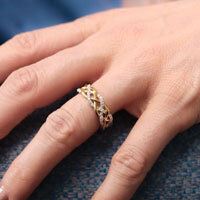
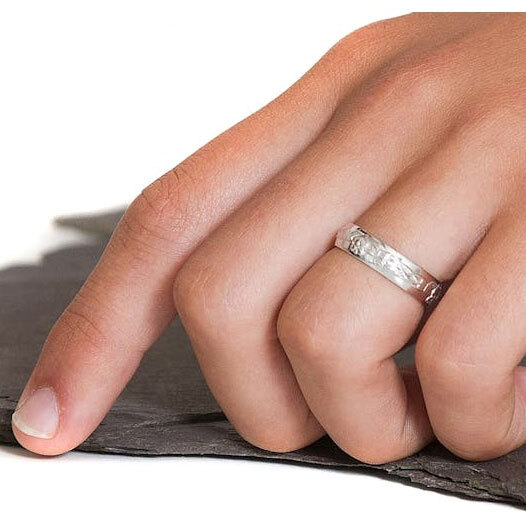
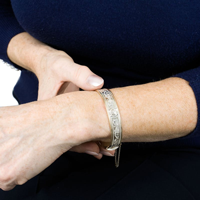
- Gemma has asked me to do a PSA reminding you to remove any cherished bracelets or rings before this next step. Jewellery safely stored? Ok, now with clean hands, knead the mix a little to bring it together to form a soft dough.
- Tip the dough out onto a clean, lightly floured surface, and shape it into a disc, or gently roll it out into a disc, no bigger than your frying pan. The disc should be between ½ centimetre and 1 centimetre, or ¼ inch to just under ½ inch thick. It is not an exact science, but you don’t want it to be too thick, or it won't cook through before burning!
- If you are cooking for a crowd and have upped the quantity, you might have to make a few discs!
- Cut a cross through the doughy disc to divide it into four equal quarters. Or, if you want to add mayhem to your morning, you can also get kids involved and use cookie cutters to make whatever shapes you like. For St. Patrick’s Day, shamrocks are a good fit, but they can be difficult to flip!
- Heat a flat, heavy frying pan on a medium-high heat. Jane doesn’t use oil or butter here, just a dry pan. The flour on the cake should stop it from sticking
- Cook the quarters in the pan for a few minutes on each side until they start to brown in patches - my youngest reckons these are leopard spots.
- Fight back the hungry hordes to allow them to cool slightly on a rack.
- Add a generous spread of butter and let it melt in, then serve with whatever you fancy for a filling and festive brekkie! Eat while still hot, then head off about your day of celebrations with a pleasantly full tummy!
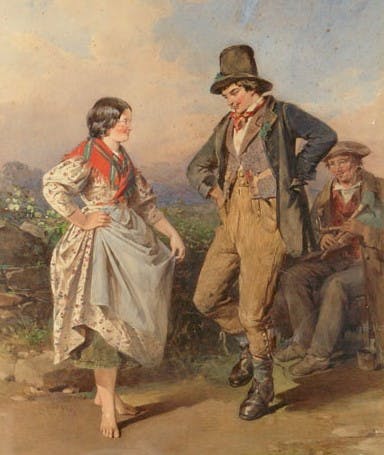
Celebrants on March 17th, (perhaps fueled by potato cakes?) St Patrick's Day, as depicted by Henry Parsons Riviere.
What's Next?
Check back in with us tomorrow for Day 2 of our St. Patrick’s Day countdown, or open door number 1 of our 17 Days of St. Patrick’s Day offers! And, of course, if you would prefer a shamrock, or any other Irish symbol, made of silver or gold rather than potato, just get in touch. We would be happy to help you find the piece of Ireland you have been waiting for.
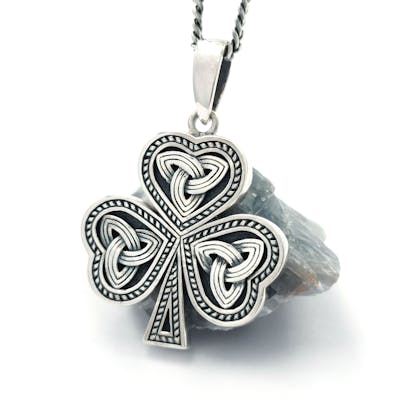
Shamrock for St. Patrick's Day and All Year Round
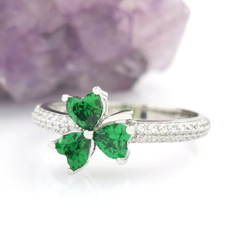
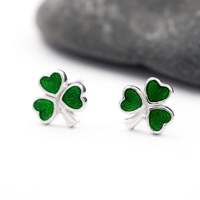
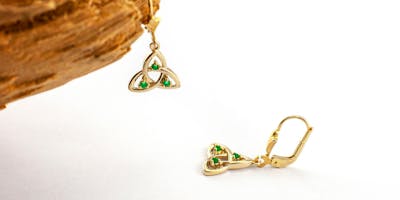
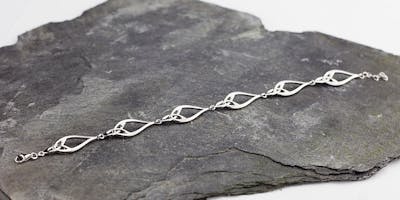
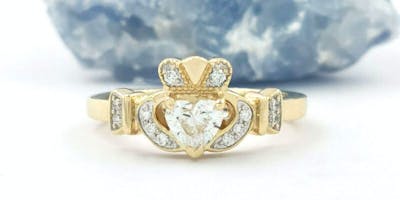
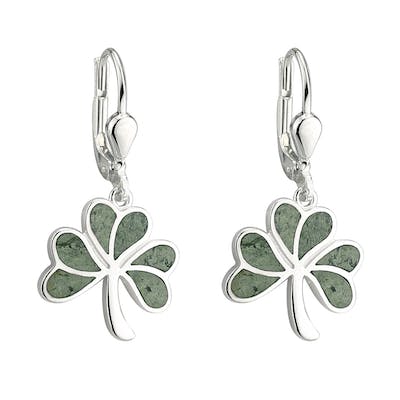
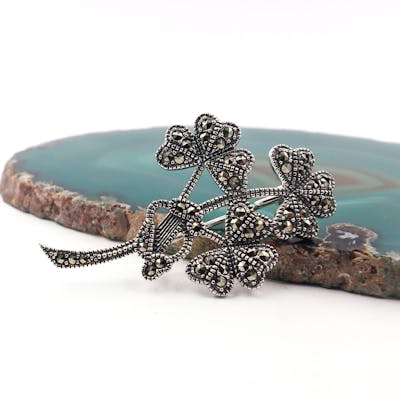
Our lovely Shamrock jewellery designs preserve the delicate beauty of this three-leafed symbol of Ireland in silver and gold, with carefully crafted pieces to be cherished year round. Whether you prefer to wear your shamrock as a pendant, bracelet, earrings, or ring, we have a piece to suit!
Get In Touch
Have a question or something you're not entirely sure about when browsing our pieces? Please reach out. You can send us a note or give us a call—the Dublin workshop is here to make sure that you have a perfect experience from start to finish with My Irish Jeweler.
Follow us on Facebook and Instagram, to see what's new and upcoming. Join our Email list for early offers and special features.

Ciaran
My Irish Jeweler
Born in Co. Antrim and reared in Dublin, I was fascinated with Irish culture from an early age. I suppose it's not surprising given my mother inherited a grá for the Irish language from my grandfather, an Irish school headmaster. And that grá continues! My brother and sister are now Irish teachers, my niece is an award winning Irish dancer, and I proudly work to share Irish culture through our Irish and Celtic Jewelry at My Irish Jeweler!
I love researching and reading about the history of Irish design. It's at the core of what we do here at My Irish Jeweler. I find much of it so interesting that I have to share what I find. I hope you enjoy it!
Comments


 Ask Gemma