Púca, prounced "poo-ka" is the Irish word for spirit or ghost. And though the term sounds like it could be a general one for any manner of ghost or spirit, it most often refers to a very specific type of supernatural creature. Read on to find out what exactly is a Púca, where and when you might have the misfortune to encounter one, what is to fear from one, and why it is celebrated in Ireland today.
What is a Púca?
The Púca, Pooka, or Phooka have roots that some believe trace back over 1000 years in Ireland. They are well known as tricksters and shapeshifters. They can take human form, though typically not completely. They often sport the ears, head or tail of an animal. The end result is a creature that can look truly frightening.

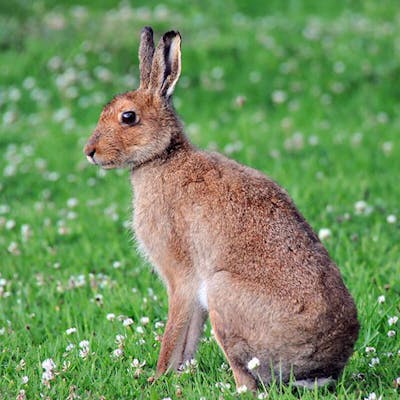
But they are reportedly at their most comfortable in full animal form. Most commonly appearing as horses, but also cats, dogs, hares, birds, foxes, wolves, goats, or some unsettling mixture of several creatures.
They are said to have the power of human speech and unlike some other supernatural creatures, they are reportedly not at all shy!
With all that variation, you might be forgiven for wondering how you would know if you met a Púca? What unites all descriptions of this spirit is that they are all typically dark in colour, with dark hair or fur and otherworldly glowing eyes. They are also said to be solitary. So it would be unlikely to have the misfortune to meet a group of them. But if you did, the plural is púcaí.
Where and when would you find a Púca?
The other common thread in all stories of the Púca is where and when they are encountered. This figure of chaos is a creature of the countryside preferring lonely spots where they are less likely to be disturbed. You won’t find one in a city or town centre. It prefers to live on the edges where it has freedom to roam and make mischief. Most stories of the Púca start on lonely boreens (small roads or paths) late at night.

A lonely Irish contry lane... perfect for a Pucá encounter!
Often the person who encounters a Púca has recently left the cozy confines of a pub with a drink, or two, on board! In some tales, the encounter with the Púca puts a person off drinking for life! So those that don’t wish to encounter this spirit best stay away from late night drinks in the country!

The place where many tales of an encounter with a Púca begin… a cosy pub. This is the appropriately named Cosy Thatch Pub in Kilmeadan, Co. Waterford.
However, there are records of people as sober as a judge encountering a Púca. These poor folks are left, for all intents and purposes, with a hangover and a hazy recollection of a nightmarish night. So really, unless you want to take your chances, it’s advised not to go wandering the countryside at night in Ireland!
Should you fear a Púca?
So what really is there to fear from a Púca? They were certainly feared by many, particularly children, and especially in the 19th century.
In their preferred form as a black horse, they had a habit for abducting lone travelers on roads late at night and taking them on terrifying and wild rides across the countryside. They might drag you through hedges and ditches, ripping your clothes and giving you the odd scrape. But the Púca typically never does its captives any lasting harm.
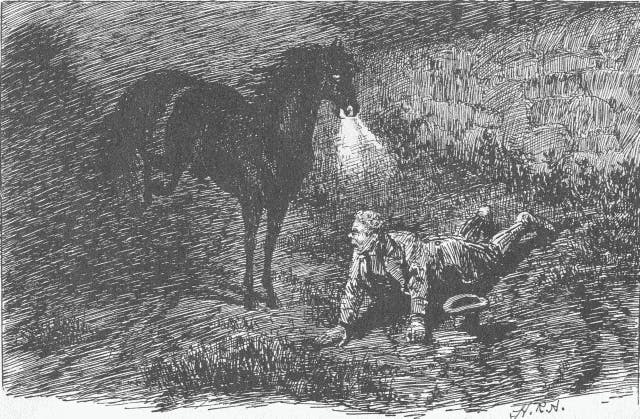
Dennis And The Púca from the Book of Irish Wonders by D R Mc Anally Jr
Photo Credit: Public Domain
It has even been known to be a helpful or protective spirit in some tales, defending or protecting a person from other, worse, supernatural dangers.
The Púca is associated with the harvest, with a dedicated celebration at Samhain. Some in Ireland even called Halloween “Púca night.“ Farmers that were respectful of the spirits might leave a small patch of their fields unharvested as the “Púca’s share.”
Young children are warned not to pick wild berries after November 1st as they’ve been claimed by the Púca on Samhain, usually by spitting on them (or worse)! Woe betide someone that took the Púca’s share!
Where does Púca come from?
There is considerable debate over the origin of the word Púca. Some scholars contend it is an inherited word from Germanic or English. While others believe in a Celtic origin from Old Irish or pre Irish. But there are no references to it in early writing.
There are mentions all over Irish folklore, as a sort of “bogey” to scare children, to keep them in line and get them home before dark, especially in the dark months of winter! There are over 600 entries relating to the Púca, another 149 for Pooka, and 17 results for phooka in the National Folklore Collection. There are also a huge number of places names around Ireland that include the word Púca in all of it’s forms.

A photograph from 1985 of the Waterfall at Poulaphouca, which roughly translated is the Púca's hole or hollow, in Co. Wicklow
Are they still about? The Púca today
Though the belief in the Púca has waned a great deal, it remains a controversial creature in Ireland. A large statue commissioned to depict this spirit in 2021 by award-winning artist Aidan Harte caused ructions in a small town. Many residents didn’t want such a nightmarish figure standing in their midst unsettling them as they went about their day. So the council took the extraordinary decision to banish the creature from the town!
Happily, this Púca eventually found a home in 2022 a short distance away, fittingly in Poll a’ Phúca (The Lair or hallow of the Púca). Firmly ensconced in this more sylvan setting at the Michael Cusack Heritage Centre, this Púca now stands before visitors during the daylight hours too, and the brave rub his toe for a bit of good luck!
The Púca on the Page, Stage and Screen
Iconic Irish poet and playwright W. B. Yeats saw the spirit as an eagle. Another Irish writer Brian O’Nolan, a.k.a Flann O’Brien, was also so inspired by this mischievous creature - Pooka MacPhillemey, a tricky character in O'Brien's novel At Swim-Two-Birds, is a “member of devil class.”
This trickster has also cropped up on the silver screen. The six foot tall “rabbit” in the 1944 play Harvey, later adapted into the 1950 film starring James Stewart, is referred to as a "pooka." And it makes an appearance in the 1959 Disney film Darby O'Gill and the Little People too!

A poster for the film Darby O'Gill and the Little People (1959).
This pooka appears as a horse with a coat that keeps changing colour. It mischievously knocks Darby down into a cavern full of leprechauns, landing him in a world of trouble. It also nearly kills Darby's daughter Kaitie, by leading her up a hill in a dark storm, where she suffers a terrible fall. Certainly not a spirit to be trifled with!
Celebrating the Púca
Perhaps it is this danger, darkness, and mystery that seems to keep drawing people back to this tricky spirit. The Púca is now the namesake of one of the biggest Halloween celebrations in Ireland. Four nights, at the end of October and start of November will see visitors to the Púca festival enjoy music, myth, merriment and mischief, mixed with some folklore, fire, and feasting. We're sure the Púca would approve this celebration of the arrival of the darker half of the year!









 Ask Gemma























Hi! I have been super into Celtic folklore for most of my life. I live in the southeast US, in Georgia. I have always felt a connection to Scotland, Wales and Ireland. Scotland especially. And I am learning Welsh right now! I love all these stories and first came across the pooka years ago in Brian Froud's faery books. There is a also a television series called Celtic Monsters that was released in 2007. It features stories from Ireland, Scotland, and Wales and has countrymen and women telling their stories. One tells a story of the pooka living with a man named Jobe Jon Harry. I bet I'm absolutely spelling the name wrong. It was centered around the town of Gwent in Wales. Have you ever heard this story? Or seen the Celtic Monsters documentary? I love your information on the pooka! Thank you for sharing.