


Samhain Stories: Witches in Ireland
Written by Gemma on Oct 27, 2025 | 0 Comments
It might surprise you to know that many of the traditions and spooky ghost stories you associate with Halloween can be traced back to our little island.

Photo Credit: Evan Swigart (CC BY 2.0)
In honor of Ireland being the Home of Halloween we’re sharing our favorite ghost stories and characters with you. In previous years, we've delved into Fairies, werwolves, and spirits like the Pùca and the Banshee! But today we are focusing on characters you are sure to see out trick-or-treating this October 31st, witches!
Witches in Irish folklore and myth

The History of Witches and Wizards (1720) Wellcome L0026615.jpg
Photo Credit: Wellcome Trust (CC BY 4.0)
Irish folklore and mythology is full of superstition and stories of magic, charms, curses and spells. So it’s hardly surprising to find that that master of the craft, the witch, crops up everywhere in Ireland.
Fewer historical witches than you would expect!
For all the "wise women" and witch like characters in Irish folklore and myth, there are much fewer historical accounts of witches than you might expect. Only a handful of people were officially persecuted here for witchcraft. This is despite the fact that the curses of women, and especially widows, were feared throughout Irish history.
So why were there no sweeping witch trials here in Ireland as there were elsewhere? Estimates vary but between 40,000 and 80,000 people, many of them women, were killed for the crime of witchcraft in Europe mostly between the 15th and the 18th century. In Ireland, there were officially two.

The title page of Malleus Maleficarum, roughly translated as The Hammer of Witches, first published in 1486. Many regard it as a handbook for secular courts throughout Renaissance Europe during the peak of the witch trials.
Photo Credit: Public Domain
We don’t know for certain why there were so few historical Irish witches, but there are several theories. For some, it shows a certain degree of comfort with the mysterious and magic. There are records in the National Folklore Collection alleging Irish priests were not above cursing those who disrespected the church, despite the fact that this activity was viewed as heretical at the time!
Another key factor, often reported, is that the Irish feared a different supernatural entity, the Sidhe or fairy folk. Perhaps the fairies took the brunt of the blame when crops failed or someone suddenly took ill, rather than the widow who lived at the edge of town?
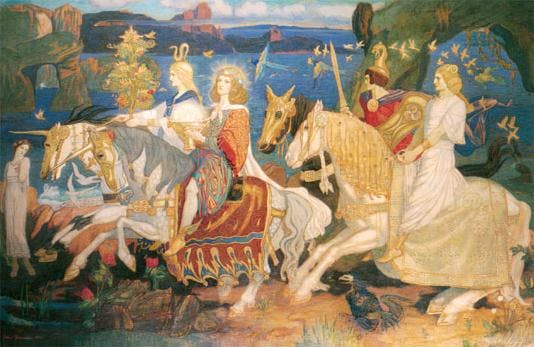
The fairies here, may not fit with what you are picturing. Celtic fairies are something all together different to those made famous by Disney, as shown in this famous 1911 painting by John Duncan.
Photo Credit: Public Domain
Known in Ireland by several names, woe betide anyone that should anger or disrespect one of “the good people” as they were also known. By comparison to these capricious, powerful, otherworldly entities, perhaps “witches” were not considered a real threat?
Famous Irish Witches
That being said Ireland does have a handful of famous witches. So let’s take a look at a few!
The Cailleach: The Original “Witch”

An Cailleach, brought to life for a Halloween parade by the Macnas Community Theatre Group.
Photo Credit: William Murphy (CC BY-SA 2.0)
The Cailleach is a figure deeply rooted not just in Irish folklore and mythology, but also that of Scotland and the Isle of Man. Feared and revered in equal measure, she is not strictly speaking, a “witch.” But she is an ancient and complicated character, certainly supernatural, and a goddess associated with the power of nature and specifically with winter. And Samhain is when she returns to take hold of the land each year. Or so the story goes!

The Cailleach in Slieve Gullion forrest park, known here by one of her other names Cailleach bhéarra or Calliagh Berra which roughly translated means "sharp one".
Photo Credit: Rossographer (CC-SA-2.0)
In modern Irish, Cailleach means old woman or hag. But the older meaning of the word is “veiled one’ and the Cailleach goes by several titles including “cailleach feasa,” wise woman or fortune-teller, “cailleach phiseogach,” sorceress or charm-worker, “cailleach bhéarra” sharp one, and very grandly in Scotland, the ‘Queen of Winter. Her season begins at sundown on October 31st, with the Celtic festival of Samhain, known today as Halloween. She reigns, tightening her grip on the land until another powerful goddess, Brigid, takes over in Spring.
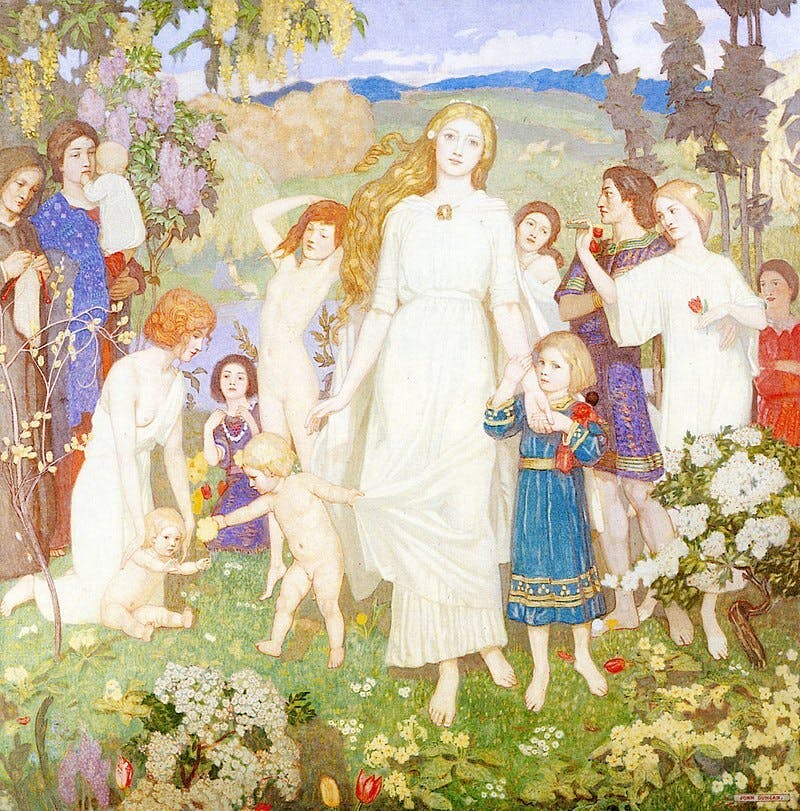
Brigid, the goddess of spring banishes the Cailleach each year, and in some tellings IS the Cailleach aging in reverse! Some magic trick!
Photo Credit: Public Domain
The Cailleach was also the goddess of grain, so at the end of the harvest the last sheath was often offered up as a gift to her. And she was said to protect animals over winter, particularly deer and birds, with the ability to shape shift into an animal herself or even turn to stone.

Legend has it that this rock in Co. Cork, is the face of the Cailleach Beara turned to stone, staring out at the Atlantic awaiting the return of her husband.
Photo Credit: Nigel Cox (CC BY-SA 2.0)
As well as turning to stone herself, the Cailleach also had the ability to shape the land. This is reflected in place names bearing her name across the Gaelic speaking world, including Sliabh na Caillí, The hill of the Crone, in Co. Meath. This spectacular and ancient site at Loughcrew complex is a site associated with the “death” of the Cailleach and the winter at the spring equinox.
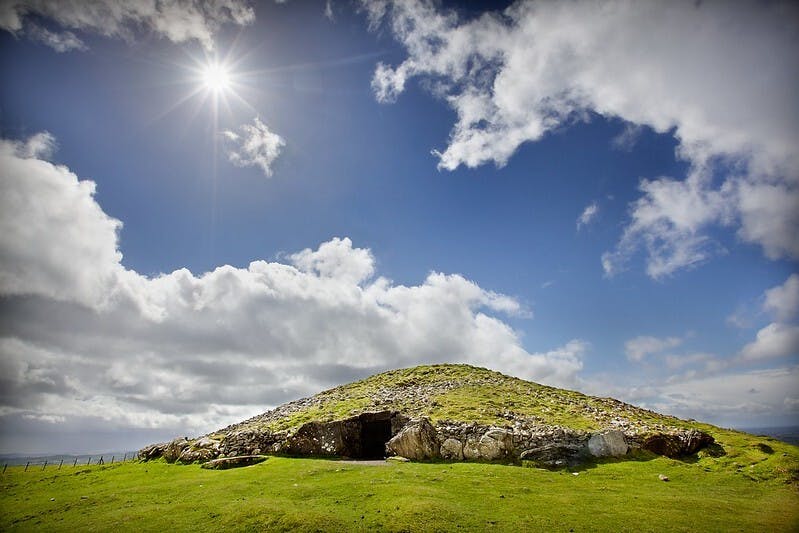
Photo Credit: Michael Foley (CC BY-NC-ND 2.0)
Alice Kyteler: Ireland’s “first” witch
Despite looking the part and being immensely powerful the Cailleach doesn't really fit the bill when we think of witches. For that we have to look from Irish myth to history and the story of Alice Kyteler.
Alice holds the dubious distinction of being Ireland’s first official witch even though she was accused and convicted before the crime of witchcraft was even on the statutes! She was the only daughter of a powerful and wealthy Flemish family who put down roots in Kilkenny in the 13th century.

Kilkenny with it's imposing castle built in 1260, was a an up and coming Hiberno-Norman merchant town where Alice was born and raised.
Alice grew up to become a hugely successful innkeeper and money lender, reportedly lending money to the English king at one point! Kyteler’s Inn was known as “a place of merrymaking and good cheer, but Alice had an unfortunate knack of outliving her husbands. She had four and accumulated a significant fortune through the course of her many marriages.
Perhaps unsurprisingly, there were rumors circulating that these deaths had links to something untoward, with whispers of murder and magic. After the death of her fourth husband, his family accused her of sorcery, no doubt motivated in part by the fact that Alice was named as the main beneficiary of his will! The families of her previous husbands joined the chorus and eventually these accusations forced officials to act.
She was charged with witchcraft, the first official charge in Ireland, along with her son William, several of her friends, and servants. Kyteler defended herself, drawing on her extensive power and wealth, and eventually escaping the country to England when the writing was on the wall, disappearing without trace.

There are more than traces of the family still standing in Kilkenny. Kyteler's Inn, first built by the Kyteler family in 1473 and run by Alice herself, is still operating today, if under different management!
Photo Credit: Elisa Rolle (CC-BY-SA-4.0)
Petronilla de Meath: holder of an unfortunate title
Alice escaped her fate. But her less well connected friends and even her son didn’t fare as well. William was convicted and ordered by the then Bishop to attend three Masses every day and to give alms to the poor.
The less wealthy or powerful women were given harsher punishments. Alice's maidservant, Petronilla, was caught up in the sorry tale and dammed by association with her employer. The poor woman from Meath, confessed to acts of witchcraft on behalf of her employer. It should be noted that this was after after prolonged interrogation and torture!
Of the back of this coerced confession, the poor maid was convicted of heresy, remember witchcraft wasn’t on the statues in Ireland. She was flogged and burnt at the stake in Kilkenny on November 3rd, 1324. She was the first person to be executed for heresy in Ireland, and one of the first in Europe to be charged with hersey for witchcraft. And if historical records are to be believed, she was the only woman to be officially tried and executed in Ireland. An unfortunate title indeed!

A sculpture by Kevin T. Fennelly at Kells Priory in Kilkenny of Petronilla preparing a fish for her employer. The priory was where the whole sorry started with Alice's first questioned there about her alleged witchcraft by the bishop.
Photo Credit: Andreas F. Borchert (CC BY-SA 3.0 DE)
Biddy Early: The wise woman of Co. Clare
This small number of executions for witchcraft in Ireland stands in stark contrast to the sweeping witch hunts that occurred elsewhere in Europe, particularly in Scotland and Germany.
Some point to the respected position of the “wise woman” in Irish culture, as yet another reason for why such events were not more commonplace in Ireland.
And there was no “wise woman” as celebrated as Biddy Early. W.B. Yeats called this notorious red-head, “the wisest of wise women”. Also known as Bridget Cleary (1798 – 1872), she was accused of witchcraft in Ireland in 1865 under the Witchcraft Act (1586). It seems she was charged after falling foul of the Church, landlords, and authorities for practicing as a herbal healer and wise woman.
But the case against her was dropped and it never went to trial, when the few witnesses against Biddy Early refused to go through with their testimony. Lacking sufficient evidence against her, Biddy was released and received continued support from her community. We know of Biddy and her life thanks to the historical record of this case, but more so from the oral tradition of storytelling in Ireland. People compiled stories of her deeds based on interviews with those whose parents or grandparents had personal contact with Biddy. And so we can tell her story today.
Ireland’s last official “witches”
Bookending the witchIn 1711 the last witch trial in Ireland and in all of the British Isles played out in Islandmagee. The trial is the subject of the spectacular Witches of Islandmagee Project which sets out the facts of this historic case in a multitude of ways and allows you to draw your own conclusions.

In Islandmagee in February 1711, the elderly widow of a Presbyterian minister, Ann Haltridge died suddenly in her home, reportedly as a result of demonic possession.
After the funeral, in March 1711, Ann’s eighteen-year old niece, Mary Dunbar, came to live at her aunt's house. Mary quickly began to show telltale signs of demonic possession too.
The young woman accused eight local women from Islandmagee of using witchcraft against her. This accusation was taken very seriously by the community. During their arrest, the women were attacked by an angry mob, with one of the accused losing an eye! The eight women were quickly tried and found guilty at the end of March 1711. They were convicted to one year in jail along with several stints in the stocks for public humiliation.
Curiously, the imprisonment of her “tormentors” did nothing to improve Mary’s condition. Mary then accused the husband and father of two of the convicted women, a man named William Sellor, of being a witch too! Between the accusation and the trial of William Seller, Mary died, making it a capital case. William Sellor was duly convicted, and although the historical records have been lost, it is widely held that he was executed by hanging.
That being the case he has the terrible distinction of being the first and the last person to be tried and executed for the crime of witchcraft in Ireland. There was no happy ending for the women either, with all eight ostracised from the Islandmagee community on their release.
The trial made a lasting impression on the community too, with the story remembered in local folklore and history. But it took until In April 2023, for all nine convicted Islandmagee "witches" to be given official recognition with Mid and East Antrim Council erecting a plaque in remembrance.
Sharing Samhain Stories
Despite the grisly content, we hope you've enjoyed reading about Irish witches. We have other samhain stories to share on our blog too - stories of creatures that lurk in the woods, or banshees that haunt Irish graveyards, and the Púca. Or perhaps you have your own spooky Irish story to share? Let us know in the comments below. We would love to hear them!
Get In Touch
Have a question or something you're not entirely sure about when browsing our pieces? Please reach out. You can send us a note or give us a call—the Dublin workshop is here to make sure that you have a perfect experience from start to finish with My Irish Jeweler.
Follow us on Facebook and Instagram, to see what's new and upcoming. Join our Email list for early offers and special features.

Gemma
My Irish Jeweler
Gemma is our head jeweler. She is very passionate about jewelry and watches. Her favorite style is Tree of Life "because family and roots are so important to me".
Comments