


The Arc of History Bends Towards...the Boyne?
Written by Vicky on Aug 16, 2026 | 0 Comments
Welcome back to Notes From Home - it’s lovely to have your company again. Last month, we went travelling in Europe, but this month, we’re staying much closer to home.
If you’ve been reading for a while, you’ll know that the My Irish Jeweler team tend to take an annual summer day trip: last year we went to see the Words on the Wave exhibition in the National Museum; in 2024, we went to Powerscourt Waterfall, and in 2023, we went tree planting in April, before four of the team went abseiling for charity at the end of June.

Sometimes, we're all allowed out together! ;) This is Powerscourt Waterfall, which we visited in 2024.
Photo Credit: My Irish Jeweler
This year, Jane asked if we liked the idea of going to Brú na Bóinne, and there was a resounding yes from all of us!
School tour vibes
In Ireland, the Brú is the sort of place you visit as a child on a school tour, where the main excitement is more about hanging out with your friends, going on the coach together, and less so the fact that you’re visiting a UNESCO World Heritage Site that pre-dates the Egyptian pyramids at Giza by over half a millennium!
Clearly I had a deprived childhood because I missed out on that particular school tour, but most of my colleagues had been at some point or another. It’s a bit embarrassing, but in the same way I’ve never actually visited the Book of Kells in my over four decades of living in Ireland, I’d also never been to visit these monuments, so this was a really exciting trip for me.
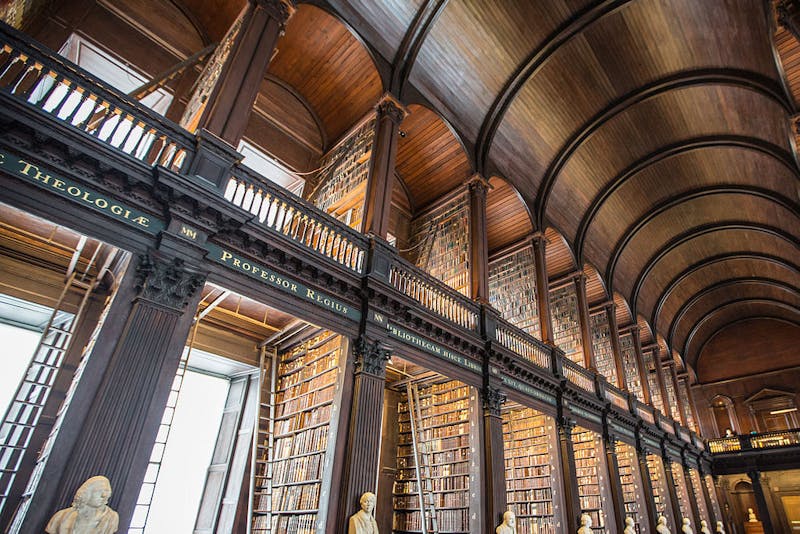
I'll make it to the Old Library in Trinity College, home to the world famous Book of Kells, eventually. An idea for next year, perhaps?
Photo Credit: Tony Webster (CC BY-SA 3.0)
We all gathered at the visitor’s centre on a Tuesday morning in July, coming from our various locations, and eager to begin our exploration of this truly fascinating site.

Ciarán got started on the way to the visitor centre - there are several viewing points on the walk down from the car par where you can catch glimpses of Newgrange off in the distance! Can you see it?
Photo Credit: J. Chadwick
There’s now an excellent visitor’s centre, where the tour starts, and it shares an impressive amount of background on the area, its history, and the myriad changes the complex has undergone over the millennia, as well as the archaeology that has uncovered so much.
I’m reliably informed that, in the schooldays of yore, this did not exist, and children were just bussed up to the relevant fields and flung out to be given lectures with little to no context in the rain. Ah, the wonders of modern educational theory - this is clearly a change for the better! Although there was lots to learn, honestly, I was keen to get flung into a field to see the real thing, so when we finally got on the bus, I was a happy camper.

Jill, Jane (who you can't see in this photo because she took it), and I were all eager and ready to go with our backpacks on! We're always up for a school trip!
Photo Credit: J. Chadwick
What is this Brú place you keep on about?
There’s some understandable confusion about what is technically known as ‘Brú na Bóinne - The Archaeological Ensemble of the Bend of the Boyne’ because, with typical Irish understatement and nonchalance, we just tend to call it all Newgrange.
That’s a significant diminution, however, because Newgrange is just one part of this “ritual landscape” that comprises 90 monuments including burial mounds, passage tombs, standing stones, and wooden ‘enclosures’, which are a sort of circle of wooden poles that are dug into the ground to keep them stable.

New grange (sic) granted protection as an ancient monument in 1882... no mention of any of the other 90 monuments.
Newgrange is the best-known passage tomb, but before we went there, we also visited its older sibling, Knowth. Knowth is arguably even more fascinating than Newgrange, which it predates by about a century. The third of the three major passage graves is Dowth, although that has not been excavated to the same degree as Newgrange and Knowth, and does not allow public visits.
Brú na Bóinne is translated as the Palace of the Boyne, and it’s best known for having the largest assemblage of prehistoric megalithic art in Europe. The complex is cradled by the river Boyne to the south, west, and east, and one of the Boyne’s tributaries, the river Mattock, runs to the north. In more recent history, it was also a site of part of the infamous Battle of the Boyne between the forces of the deposed Charles II and William and Mary of Orange.

William of Orange crosses the Boyne during the Battle of the Boyne, 1690, by Jan Hoynk van Papendrecht.
Photo Credit: Public domain
Knowth
The area that includes the passage tomb of Knowth has been inhabited for a very long time. Pre-agricultural hunters and foragers stayed in the area intermittently, and archaeologists have found burnt wood fragments from fires that date from the end of the 7th to the middle of the 5th millennia BCE.
Historically, this was a wooded area, with rich growth of nuts, fruits, wild boar, freshwater salmon and trout, as well as essential supplies of water and wood for fuel. Because of this natural abundance, Knowth likely became a gathering place and community focus, used for celebrations as well as burials and mourning.

Around this time, Ireland was covered in temperate rainforest, with places like Killarney National Park giving us glimpses of what that must have been like,
Photo Credit: Nicolas Raymond (CC BY 3.0)
In much later Irish folklore, the Milky Way is known as Bealach na Bó Finne, or sometimes Bealach na Bóinne, meaning the Way of the White Cow, and it is said to be the twin of the River Boyne - Abhainn na Bóinne. It takes no real stretch of the imagination to envision the majesty of clear skies above the Brú, and the reflection of the stars in the river, making this site feel sacred and special.

The Milky Way at night.
Photo Credit: Steve Jurvetson (CC BY 2.0)
People settled here and cleared some of the woodland for farming between 3700 - 3600 BCE; remains of homes and hearths on the site have been found and dated to this time. Bones of goats, sheep, and cattle have been discovered, along with charred grains, suggesting the inhabitants likely grew wheat. So farming was established for several centuries before work on the tombs began around 3500-3400 BCE. It’s believed that the 20 or more tombs in this spot were built over multiple generations, and their impact on the landscape indicates they were significant places of power and ritual, deeply important to the people who gathered there.
Astonishing engineering
The passage grave we know as Knowth has a 90m (295ft) circumference and is 12m (39.3ft) high. It was built with only stone and earth - it’s worth bearing in mind that there’s no record of mortar being used in Ireland for approximately 4000 years after its completion! From this, it’s obvious that the builders were true experts in their craft. The current Great Mound is estimated to weigh a quarter of a million tonnes, weighing down the two inner passages and chambers, which, like Newgrange, have stone corbelled roofs.
We can all agree that it is an astonishing feat of engineering! (Incidentally, the Hittites of ancient Anatolia - roughly modern-day Turkey - built corbelled vaults, and their earliest examples have been dated to the 16th century BCE. It’s probably no coincidence, then, that our guide at Knowth told us that the oldest bones found within the Knowth area have Anatolian DNA...).
Ten different varieties of stone were used in the construction of this monument, some of which were transported from as far away as the Wicklow Mountains, and 124 kerbstones encompass the circumference of the mound. (It was originally 127, but some have been damaged or have gone missing over the years.) Above the kerbstones, you will see small holes in the grass-covered earth mound. These are the present day homes of sand martins, who swoop and dive around visitors during the summer months, catching insects to eat and playing in the breezes that wind around the hill.

Knowth's main tomb to the left, and passage tombs 3 to the fore and 2 to the right. Spot the sand martin zooming around above!
Photo Credit: V. Lowsley
Sensory deprivation: journeying into other realms
These stones are fascinating for their intricate decorations, carved or chipped into the rock. In fact, the Knowth tomb site, including the surrounding tombs in its orbit, has more than 25% of Western Europe’s entire known megalithic artwork. It also has about 100 more carvings than any other monument within the Bend of the Boyne!
Several intriguing theories about the decorations exist, but one of the most compelling is that the shapes found in the carvings here, and which are also seen in ancient monuments all around the world and not just in the British Isles or Brittany, are common forms of visual hallucinations during altered states of consciousness. These are meandering lines, zigzag patterns, arcs and/or stacked U shapes, spirals, and lattices. Tests in laboratory conditions have echoed testimony from shamans in the northwest Amazonian tribes, and repeated studies have found that there are some shapes that seem to be hardwired into the human brain.

Carvings on Knowth kerbstones. Can you see the sand martins' nests above them?
Photo Credit: V. Lowsley
It’s believed that both Knowth and Newgrange would have been used for religious rituals other than burial, and it’s probable that the spiritual leaders of the time would have had their own version of ‘journeying’. Spending time in the complete dark of the inner chambers of these passage graves would have induced visual hallucinations, because sensory deprivation induces an altered state of consciousness without needing any other chemical initiation. It's also been conjectured that some of the carvings inside the tombs may have been created as part of the process of altering the mental state of those who retreated to the central chambers. This might be similar to the manner in which drumming is used in African, Native American, and even modern-day druidic ceremonies.

Ciarán contemplating whether he has the patience for Neolithic art.
Photo Credit: J. Chadwick
Two for the price of one
Knowth is also interesting because it has two passage graves within the Great Mound. One, discovered by George Eogan in 1967, starts from the west side and is 36m (118ft) long. The second, which he discovered in 1968, enters from the east and is 40m (131ft) long.
When archaeologists discovered the western passage, the opening was only 1m (3.28ft) high because earth and stone had slipped. The smallest person on the team that day, Martin Colfer, was asked to see if he could get his head and shoulders through the gap and relate what he could see. Initially, he said he could see about 20 yards ahead. That evening, with careful work, the opening was enlarged sufficiently that three of the team could crawl into the passage on their hands and knees, and sometimes stomachs, before they eventually found what is called an undifferentiated chamber; that is, a single chamber without offshoots.
The second, eastern, passage grave, which was found a year later, was slightly longer and had a cruciform shape - a central chamber with three alcoves - and a tall, corbelled roof. Given such discoveries, it’s probably not surprising that Eogan spent four decades working on the site, from the initial excavations that began in 1962 to 2000.

Knowth and its satellite tombs.
Photo Credit: Markiemcg1 (CC BY-SA 4.0)
Time rolls on
Sadly, you can't enter the passage tombs of Knowth, but there's so much to learn about them that you almost don't feel the need. I know I haven't covered a quarter of what we were told or a tenth of what I've read in the meantime, but here are some additional notes.
The cremated remains of 300 people have been found in this area, dating from between 3300 and 2900 BCE. Other important finds include coins from Brittany and the Orkney Islands, and Iron Age graves (circa 500 BCE) lined with stone and containing food, jewels and weapons. One grave, dated to around 50 CE, was found to contain what are believed to be twins; research on their teeth indicates that they likely originated in what is now Northern Ireland or the United Kingdom.
And while we've been talking about history in its pre-Christian era, the area of Knowth didn't just shut up shop around the 1st century. There are signs of Roman visitors in the 4th century CE, and it's thought that between the 7th and 9th centuries CE, Knowth may have been a site of royal assembly, or even inauguration. Some jewellery and cooked animal bones indicate it was likely used as a gathering spot for wealthy people.
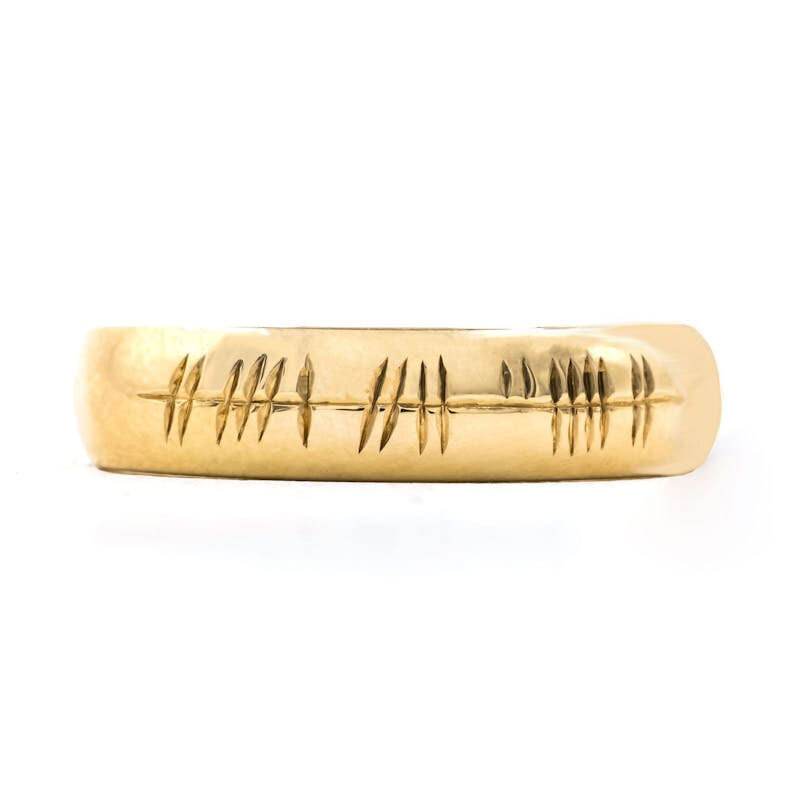
In the 8th century, graffiti was left in the tomb - both Ogham and insular script carvings have been found. Between the 9th and 11th centuries, the Great Mound and the area around it saw the development of 14 dwellings, whose inhabitants left signs of craftsmanship on the site: enamelling work, bronze and goldsmithing, and the manufacture of tools required for grinding grains and making textiles. By the 12th century, the lands at Knowth had been granted to Cistercian monks, and in the 14th century, there was a grange - a walled farm yard and dwelling - on top of the Mound. There's been a farm beside Knowth since the 18th century, and it's now known as Robinson's Farm; the outhouses have been renovated into an exhibition space where you can learn more about the artwork and history of the next-door monument.

Originally known as Knowth House, the farm was bought by the Robinson family in the 1940s, and they continued to work the surrounding land into the 1960s after the Irish Government had bought the buildings. There is now an exhibition on the building on the left-hand side of the farmyard.
Photo Credit: V. Lowsley
And...? Newgrange?!
So all of this and nothing about Newgrange yet? Well, no, not yet, but then Newgrange is generally better known, and as discussed, it tends to be shorthand for all of the Brú na Bóinne! On the other hand, it's a magnificent sight, and one that I've been longing to see for years now. Given the rather ferocious heat we've been having in Europe this summer, Newgrange itself appeared a little bedraggled from the distance, its usually lush green dome looking decidedly lacklustre and brown. On the other hand, we got to go inside, and that was pretty mind-blowing!

The first glimpse!
Photo Credit: J. Chadwick
It's a quick coach ride from Knowth to Newgrange, and as you meander down winding roads, there's plenty of charming scenery to see and people-watching to do. When you exit the coach, you again feel rather as if you're on a school trip because you wait at an assembly point until your guide comes to fetch you. (Having first been given strict instructions by the driver about what time your coach will be leaving!) Ambling up the path that brings you round to the front of the monument, you find yourself all too soon in front of that often pictured entrance stone and, if you're me, you take several very deep breaths!

Photo Credit: J. Chadwick
Somehow, it felt as if we were told less about Newgrange on our tour, but perhaps it's because you're expected to know the basics already - I'm not sure. Let's recap in case you're coming to this fresh!
Taller than Knowth, but smaller in circumference, Newgrange is about 13m (43ft) in height, and around 85m (279ft) around. The front of the structure is known for its white quartz cobbles interspersed with black stones, which contribute to its commanding presence. It also has 97 kerbstones around the outer circumference, and a 19m (62.3ft) passage that opens out into a cruciform-shaped inner chamber with a corbelled roof of roughly 6m (20ft). Its inner build is covered over by an estimated 200,000 tonnes of stone and earth to create the domed shape.
Above the main entrance, and behind the carved stones, there is a recessed opening known as the roof box. (I think it's very cute that this was the name Professor Kelly gave it in 1967, and no one bothered to change it because they couldn't come up with a better descriptor. It's just as well it wasn't just called 'the yoke', I suppose!) It is through this that the famous shaft of sunlight (assuming that it's not cloudy) will pierce the heart of the monument on the morning of the Winter Solstice. People still come from all over the world to experience this annual event, which they apply for through a lottery.

A fantastically disgruntled-looking cow in a precarious perch over the roof box many moons ago.
Photo Credit: National Monuments Service
Going in...
When you get the opportunity to enter the tomb, it's best to leave any bags you may have with you outside, because it can be a bit of a squeeze in places as you move along the passage into the central chamber. (Your guides will ask you to carry any bags in your hands rather than on your back, but it's much simpler to leave them under the stairs that take you to the entrance.) As you're not allowed to take photographs or video footage inside the passage grave, you'll want to put your phone away, too, so you can soak up every second of the time you get inside this ancient space.
As you walk along the constrictive passageway, stooping on occasion and admiring the carvings you pass, the opening into the central chamber can be a bit of a revelation. All of a sudden, there is space, and a very tall roof. Take a second to imagine all those stacked boulders above you, holding up the ceiling now as they have for over 5000 years... Take a look in each of the alcoves - one to the right has a carved basin in it that almost looks like a bath. One wall on the left has graffiti on it - history in its own right as it's not new - and, if you can, find the silence as you stand under the weight of stone and earth. The tour guide will show you how the light comes in on the Solstice, and to do so, they will turn off all the lights. I've become a little bit in love with true darkness - especially because it happens so infrequently here in the countryside during the summer months - so this was a second or two of absolute ease for me, but if you don't like the dark, be aware. It's very dark! Really, very dark and very quiet. You can see why it would have been a rite of passage - no pun intended! - to spend time there alone and in that blackness, but a little bit of me desperately wanted to hide in a corner and stay overnight!

Seven entered, and seven left! (Ruth was taking the photo.)
Photo Credit: R. Chadwick
Nonetheless, we all departed intact and had time to walk the circumference of the monument before we had to catch our coach back to the outskirts of the visitors centre. Although there are fewer carvings here than there are at Knowth, the Newgrange stones are intricate and beautiful. They are also the only stones to have carved triple spirals (or triskeles) anywhere in the Brú complex, or in Ireland, dating from that period.

K52, the 'false' entrance stone, on the opposite side of the mound to the famous K1 entrance stone.
Photo Credit: J. Chadwick
And now to lunch!
You can be sure that, after wandering back from the coach stop to the visitors centre, we were certainly ready for some food. We did loiter on the bridge because we thought we saw a heron, and as you know, you can never overlook a heron. Sadly, the sighting was inconclusive.
We decided that lunch was definitely in order; however, as any museum or national monument visitor knows, before you leave, you have to visit the gift shop! This one is an absolute treat, and I picked up a couple of books because it would be rude not to, really... One book, simply called Knowth, published by the Royal Irish Academy, is a short and sweet collection of articles about the site, with eight chapters on different aspects of the site by experts directly involved in its archaeology and care, including George Eoghan himself. The second is called Inside the Neolithic Mind by David Lewis-Williams and David Pearce; I'm about halfway through it, but I have to keep stopping to underline things - it's utterly fascinating! I also added a guidebook about Loughcrew to the mix, but I haven't got to that one yet. Might have to take it with me the next time I visit.

T-shirts come and go, but books are forever! ;)
Photo Credit: V. Lowsley
Have you been to the Bend in the Boyne?
So that was our expedition to one of the three UNESCO World Heritage Sites in Ireland; the other two are Skellig Michael and The Giant's Causeway - add them to your list of places to see, because they really are magnificent.
Do you want to learn more? There's a huge amount of information online, including videos on YouTube. This is one of the best I've found so far, even though it's on the older side.
Have you visited Knowth or Newgrange? Please share your stories in the comments - we'd love to hear your experiences!
Get In Touch
Have a question or something you're not entirely sure about when browsing our pieces? Please reach out. You can send us a note or give us a call—the Dublin workshop is here to make sure that you have a perfect experience from start to finish with My Irish Jeweler.
Follow us on Facebook and Instagram, to see what's new and upcoming. Join our Email list for early offers and special features.

Vicky
My Irish Jeweler
My Welsh grandmother introduced me to two of my great loves in life before I was four years of age: she taught me to read and, under careful supervision, permitted me to look through her jewelry box. Stories and shiny things have been my passions ever since!
In the forty years I have lived here, Ireland has changed dramatically in virtually every aspect. Among its constants, though, is a rich tradition of decorative adornment and storytelling in all its forms: from the ancient carvings at Newgrange, the beautiful golden torcs in the National Museum, and the world-famous Book of Kells, to our modern designers, writers, musicians, and craftspeople. Celtic creativity is more powerful today than ever, and that is why it's my honor to share our stories and witness yours.
Comments


 Ask Gemma