


The Great Saltee Adventure.
Written by Vicky on May 18, 2026 | 0 Comments
Welcome to May’s Notes from Home blog - it’s lovely to have you with us again! The sun has finally returned to our fair land after what felt like years of greyness and gloom, and you can be sure that all the folks here have been busy soaking up the light and warmth available. It's the time of year when I get really excited about having solar panels!
Last month, I regaled you with stories of The Butter Museum in Cork, but this month, we’re moving further east to the county of Wexford, my erstwhile temporary home! Actually, technically, we’re heading off the coast of Wexford, because a boat trip was involved…

Sailing away in the salty air with scowling clouds. It had been sunny all week beforehand - typical!
Photo Credit: J. Chadwick
Unlike the west coast of Ireland, which has islands scattered along its length, the east coast is slightly…smoother. With counties Wexford and Waterford known as the Sunny Southeast, we’ve already shown that it’s a wonderful region to explore, with everything from Viking towns to the Copper Coast UNESCO Global Geopark, as well as the Waterford Greenway, where our intrepid adventurers visited in 2024.
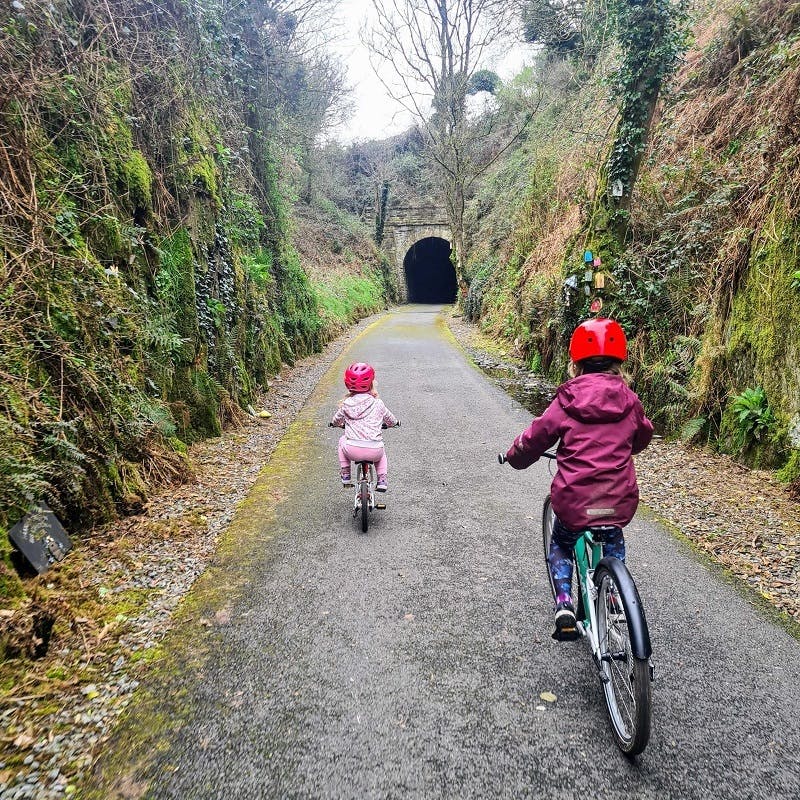
Adventuring along the Waterford Greenway.
Photo Credit: J. Chadwick
A Saltee sanctuary
Less obvious, perhaps, and almost certainly a little trickier to get to are the Saltee Islands: two small and wild outcrops in the St. George Channel that lie approximately 5km off Kilmore Quay. Both privately owned - of which more anon - the Great and Little Saltee islands are havens for seabirds, and other wildlife. They provide a safe nesting spot for fulmar, gannets, kittiwakes, guillemots, razorbills, shags, cormorants, and (most adorably) puffins.

An opportunity to visit a real life "Puffin Rock" was a natural fit for Ciarán and his family as self-professed fans of this hit Irish cartoon.
Photo Credit: J. Chadwick
There’s also a grey seal colony that raises its pups in the coves along the shore in autumn. It’s sometimes possible to see Risso dolphins or even Basking sharks from the islands, although that’s definitely not an everyday occurrence! In the summer months, migratory land birds, as well as moths and butterflies, take advantage of the opportunity to stop for a rest and refuel.

Photo Credit: J. Chadwick
The Saltees are one of our most significant seabird sanctuaries, considered vital to the well-being of the creatures that live there. They have been designated a Special Area of Conservation for their grey seal population and marine habitats, and a Special Protection Area for 10 species of seabirds. These Areas extend over both islands and the surrounding sea, covering over 15,000 hectares. The National Parks and Wildlife Service also made the decision in 2025 to hire Seabird Wardens in an attempt to protect the nesting birds that raise their young on the island. We will see later that there was an alarming population decline in the late 2010s…

Photo Credit: J. Chadwick
Don't you mean Salty? Why the weird spelling?
Well, sort of. It's conjectured that the islands get their name from the Danish Vikings, who settled in the region in the 9th and 10th centuries. In the original Norse, they were called salt øy, or Salt Island. Apt, as the harsh seas that rage around the shores during storms lash the islands with salt spray. Kilmore Quay is connected to Little Saltee via a natural causeway now known as St Patrick’s Bridge. Still visible at low tide, it would have offered access by foot in centuries gone by, with a short boat ride to get to Great Saltee. These days, it’s considered too dangerous to use and is primarily known for causing shipwrecks and endangering boats!

A sight to strike fear into any Irish monk in the 9th century.
Photo Credit: Barnabas Davoti on Unsplash
Let's look at the history
The Saltees have a long history, and it’s thought that people may have lived on the islands as early as 3500-2000 BCE. Neolithic finds have been made, and structures resembling promontory forts, dating to the late Bronze Age or the Iron Age, have been found. These are defensive positions built on steep cliffs, often accessible by only one route, and where the landscape provides natural defensive advantages..

Dunbeg promontory Fort , Co. Kerry , Ireland
Photo Credit: Methos31. CC BY 2.5
There are grave sites on both islands, and it seems likely that a monastic site existed on Great Saltee from the 8th century. (We know how much the Irish monks loved an island, and living on Great Saltee would have been a picnic in comparison to life on Skellig Michael!) The point of Great Saltee closest to the Wexford coast is still known as Abbey Point, and there are 19th-century written accounts of ruined buildings that appeared to be monastic.
Tellingly, an Ogham stone was found on Great Saltee in 1925, indicating the presence of seasonal or permanent residents around 800 CE. The stone is now housed in the County Museum at Enniscorthy Castle, where people can visit it without having to take a boat! Apparently, when it became known locally that there was an Ogham stone on Geat Saltee, some enterprising local tried to steal it. Their return trip from the island took them through some rough weather, and the stone fell out of the boat - thankfully, it was retrieved the following spring and kept safe by a local clergyman. Phew!
The Middle Ages to Tudor times
We know that the islands were granted to the Cathedral and Church of Christ at Canterbury by Hervey de Montmorency around 1177 CE. (Hervey was uncle to Strongbow, the Anglo-Norman knight who came to Ireland in 1170 to aid the deposed king of Leinster, thereby inadvertently setting in motion eight centuries of the English claiming that Ireland was totally theirs, thank you very much!) Hervey had likely been given the islands and a holding of land in that region, but subsequently decided that the Church might appreciate a gift. The Archbishop of Canterbury, Thomas à Becket, had been murdered in his cathedral in 1170 and was canonised within three years, making his shrine immediately one of the most important pilgrimage sites in England. Also, the cathedral had just completed a seven-year rebuild, so any additional source of revenue or land would have been welcome. What the cathedral did with the islands, or what they thought of the gift, is lost to the mists of time. Maybe just as well...

A rather grumpy looking Thomas à Becket memorialised in stained glass in Canterbury Cathedral.
Photo Credit: HVH - CC BY-SA 3.0
The next record of the islands dates to 1245 CE, when they are referred to in the charters of Tintern Abbey in New Ross as ‘the two islands of Salteye’. Tintern Abbey was built around 1200 CE on lands belonging to the de Clare family. (Note: Strongbow’s mammy called him Richard de Clare before he got his manly nickname!) The daughter-house of Tintern Abbey in Monmouthshire, Wales - also founded by a de Clare, in case you’re keeping track - it was the third wealthiest Cistercian site in Ireland in its time.

The beautiful Tintern Abbey in Wexford - well worth a visit if you're in that neck of the woods.
Photo Credit: Tuatha
We know the Saltees have been farmed over the centuries, so it’s possible that crops were grown here for the use of the abbey, or perhaps for trade. Henry VIII’s epic divorce tantrum of 1533-1534, which led to England breaking up with Rome, and to the Dissolution of the Monasteries between 1536 and 1540, meant that Tintern was suppressed and its holding forfeited to the Crown. Several noble families leased the islands in the 16th and 17th centuries, but from the 17th and into the 18th century, the main headline was pirates!
Why is the rum always gone? *
*With apologies to the writers of Jack Sparrow. But it's a good question...
I’ve read suggestions that up to 15% of historical pirates in the Caribbean were Irish, but in fact, you don’t have to head off to warmer seas to find pirates. (Although, let’s be honest: you might prefer to!) They were rife in Ireland from around 400 CE - St Patrick was captured by Irish slave raiders, remember - to the 18th century, and could be found all around the coast. From Grace O’Malley in Co. Mayo to William Lamport from Co. Wexford, Anne Bonny, who sailed with John Rackham in Nassau, and the pirates that stole Richard Joyce from the Galway coast, Irish history abounds with outlaws upon the high seas.

Anne Bonny, famous for her exploits in the Caribbean, was reputed to have been born in Cork.
Photo Credit: Public Domain
The Saltee Islands, with their rocky shoreline and hidden caves, were perfect for smugglers and pirates to retreat to. They knew the treacherous areas of rocks to avoid when sailing in and out, as only locals can, and this afforded them great protection. Irish writer Des Ekin notes that "often, piracy was a valid form of political protest." In writing his 2018 book, Ireland's Pirate Trail, he mentions that he was surprised to learn "that Oliver Cromwell described his infamous massacre at Wexford as a reprisal against the region’s politically motivated pirates." (This was the Sack of Wexford, which took place in October 1649.) As the islands lie on the main shipping route from England to the US, and we know the sea there is tricky, foreign vessels would have made easy prey to pirates and smugglers. Even if ships weren't ambushed by pirates, shipwrecks alone indicate that all manner of goods may have 'fallen off the back of a lorry' over the centuries. Almost certainly including rum! The seas around the Saltee Islands were often called The Graveyard of a Thousand Ships - how’s that for dramatic?
One of the most famous stories of the Saltees involves a particular attempt to use Great Saltee as a hiding place. During the 1798 Rebellion, after the Battle of New Ross, the fabulously named Beauchamp Bagenal Harvey, who was a Commander of the United Irishmen, fled to Great Saltee hoping to evade capture by the English. In doing so, he hoped to board a ship that would take him to France and safety. He was accompanied by John Henry Colclough, whose family had had connections to the Saltees for at least a century and a half prior to this. We know that the family were also involved with Tintern Abbey - the current-day restoration of the abbey includes the Colclough Garden.
Legend has it that Mr Bagenal was washing himself in one of the many inlets when the soldiers searching for him saw soap bubbles in the water and captured him. It's more likely that one of his troops betrayed him, but whichever way it happened, they were both arrested and subsequently executed in Wexford Town. Bitter proof, perhaps, that cleanliness really can bring you closer to God...

'Apprehending the Rebel leaders, Harvey and Colclough among the Rocks near Wexford'. An engraving by Ambrose W. Warren, circa 1802.
Photo Credit: National Army Museum, UK. (Public Domain.)
The 19th and early 20th centuries
A publication by Samuel Lewis in 1837 noted that there were around 20 people living on Great Saltee, and a family of three on the smaller island. There are a number of ruined buildings that correspond to that period, although we have no reason to doubt him or his book, A Topographical Dictionary of Ireland. In fact, you can look through his entries online here. He notes that Great Saltee comprises "about 130 acres, of which about one-third is under tillage and the remainder in pasture; and from the abundance of sea-weed found on its shores, it is rendered peculiarly fertile." He also wrote that the island "is frequented by a great variety of wild fowl that breed here during the summer months; it is consequently much visited by shooting parties." As the island was then owned by the Morgan family of Johnstown Castle, it's likely that parties of the gentry were regularly shipped over for sport.
At that time, two men from the local Crossfarnogue coast guard station were stationed on Great Saltee. Although the famous Hook Head lighthouse stood to the western edge of the bay, Lewis observed that it was a "large bay with a continual in-draught and heavy sea setting in towards the shore, and dangerous from rocks and shallows, known only to persons well acquainted with this coast. Numerous vessels have been wrecked here: should a vessel get too far into this bay, it is impossible to beat out, and there is no place of refuge except Fethard, which, though it has a small pier, can afford no shelter from the shallowness of its water and its exposed situation."

A map of the area around the Saltee Islands.
Photo Credit: Google Maps
Possibly owing to all that seaweed, the islands were farmed extensively throughout the 19th century, ceased around 1900, and resumed in 1939, continuing until 1943. New potatoes and barley were the main crops and were evidently successful. In the early 1940s, however, its status changed dramatically.
A micro-nation is born
Prince Michael Neale (yes, just like His Royal Purpleness, that really was his name!) would lie in the grass, gazing out at the Saltee Islands as a child, imagining a world away from his own small life as a farmer's son. He thought it might be paradise to live among the birds and seals, away from the hard work on land. At the age of 10, he surprised his mother by announcing, determinedly, that one day he would own the islands and become a true prince of his own nation. His mam may have taken it as a throwaway daydream by her young son, but it seems she underestimated his levels of motivation!
As a grown man, Mr Neale became the foremost manufacturer of cattle dip in the country. It might not have been the most glamorous of callings, selling pesticides, but it was clearly lucrative. By 1943, he was wealthy enough to make his boyhood dream come true, and he bought Great Saltee. Married to Anne, a Liverpudlian, whose thoughts on his actions are unknown, he didn't stop at just buying the island.
On September 11th, 1944, Time reported:
Europe had a new royal house last week. In Dublin newspapers appeared a personal pronouncement: “I, Prince Michael Neale, landowner, will assume the title of Prince of the Saltees at the conclusion of the war. Also I wish it to be known that no one will be permitted to enter the Saltee Islands without a permit issued by me. Anybody caught interfering with the millions of birds or their eggs which inhabit those islands will be severely dealt with."
In the days before private islands and luxury tourist resorts/golf courses had cause to be as morally questionable as they are today, Michael planned to plant thousands of trees and create a refuge for the wealthy. However, time on the island may have changed his outlook because, in the long run, he built his family a very modest house and left it at that. Faced with the exuberance, noise, and - very importantly - the smell of that many seabirds may have adjusted his perspective somewhat!
He did flatten some ground to serve as a runway for a small plane after learning to fly, and if you visit the Famous Wexford People in History Facebook page, you can see him looking exceptionally dashing in a 1940s flying outfit, complete with goggles and a neat little moustache. He also decided that assuming the title of Prince of the Saltees was insufficient without a throne to be crowned on.

You didn't expect Ciarán to walk past a throne without trying it for size, did you? I think we can all agree that he looks very regal.
Photo Credit: J. Chadwick
Michael imported a throne, a monument to welcome visitors, and an obelisk, as well as some robes, and held a coronation in July, 1956. The throne has a special inscription, which is far more endearing than one might initially suspect of someone who crowned themselves sovereign of their own island:
This chair is erected in memory of my mother to whom I made a vow when I was ten years old that one day I would own the Saltee Islands and become the First Prince of the Saltees. Henceforth my heirs and successors can only proclaim themselves Prince of these Islands by sitting in this chair fully garbed in the robes and crown of the Islands and take the Oath of Succession - Michael the First.
Irish men and their mammies... It's a tale as old as time!

A royal proclamation.
Photo Credit: J. Chadwick
The Neale family - Prince Michael, Princess Anne (no, definitely not that one!) and their four sons and one daughter - never lived on the island full-time, but they tended it carefully nonetheless to ensure that the wildlife would flourish. From 1945-1950, more than 34,000 trees and varieties of shrubs were planted - apparently, the Cordyline Palms did best and can still be seen today. On the welcome monument, Michael had the following words engraved:
"All people young and old, are welcome to come, see and enjoy the islands, and leave them as they found them for the unborn generations to come see and enjoy." - Michael the First.
The irrepressible Michael I died in 1998, and the island was passed down to his five children: Michael, John, Manfred, Paul, Richard, and Anne. They have continued the tradition of keeping the island open to the public, and the flag still flies when the Neale residence is inhabited.
Michael erected a frankly huge family mausoleum in Bannow Bay in the old St Mary's churchyard. I visited this spot in 2022 while spending a long weekend in Co. Wexford, and it certainly made me curious about the Saltee Islands!

The imposing structure of the Neale family mausoleum in Bannow Bay.
Photo Credit: V. Lowsley.
The building completely dwarfs everything around it, despite still being somewhat hidden by the ruined church. It has plenty of visitors, as the churchyard is a pleasant, breezy spot to visit on a hot summer day. When we visited, the only suitable descriptive word would have been 'arid', and the monument's stonework is perfectly suited to its environment, although it must be said that the locals had mixed views on the new edifice. The word 'eyesore' was used more than once, I believe. It's certainly out of keeping with the surrounding graves, but then, if Michael embodied any Irish idea, it was undoubtedly that of Notions!

Bannow churchyard's front gate. The Neale family mausoleum is at the back of the church.
Photo Credit: V. Lowsley.
A word on Little Saltee
But only a short one, I promise. As mentioned, Little Saltee is not accessible to the public; it remains privately owned. Although it's only half the size of the main island, Little Saltee remained inhabited until the end of the Second World War. It's owned by the Grattan-Bellew family, direct descendants of Henry Grattan through his granddaughter Pauline, who married Thomas Bellew from Galway in 1858. The current owner is Sir Patrick Charles Grattan-Bellew. He has introduced Kerry cows and Soay sheep onto the island to keep the birds company.

A Soay ewe - the breed is descended from a population of feral sheep that lived on the island of Soay, 40 miles to the west of the Scottish Isles. They're small, robust, and are used to living on windswept, cold outcrops of rock!
Photo Credit: Tomek Augustyn - CC BY-SA 2.0
Visiting Great Saltee
OK, well, that brings us through most of the history, I think. I'm almost certain I've missed things out, but on the other hand, if you've made it this far, you deserve a little less lecturing and a little more light entertainment!
You will have gathered from all of the above that you need to take a boat out to Great Saltee. The Saltee Ferry runs daily from April 1st to August 31st from Kilmore Quay, and while most of the journey is made in one of their small boats, the final landing is made by RIB. This means that, depending on the tide, you could have a wet disembarkation onto seaweedy rocks. To that end, wellies or waterproof boots are always advisable! Camping, lighting fires, or staying on the island overnight is forbidden, and the ferry drops you off for 3.5 hours, telling you when to be back at the shore for the return journey. As people are at pains to point out, there are no facilities once you arrive, so you need to bring everything you need for your trip and be prepared to carry it for the duration: snacks, wet weather gear, and things to drink - but maybe not too much to drink, because there are no toilets there either.

Landing on the island via a RIB, waterproof, sturdy footwear is essential.
Photo Credit: J. Chadwick
Walking the island paths
Pathways are clear on the island, and visitors are encouraged to stick to them - in fact, it's vital that they do. The puffins that come to Great Saltee to breed lay their egg in an underground burrow. This means that leaving the path and venturing too close to the birds takes you onto uneven, potentially treacherous ground, likely to contain burrows that might give way beneath your feet. The cliffs aren't fenced or railed, so a tumble at the cliff edge is no minor fall and could well be fatal.
For the puffins, who are used to seeing humans who keep their distance, finding a large creature near their nest is frightening and may cause them to abandon their home and their egg. An abandoned egg will not hatch, and the population suffers as a result. This really doesn't seem necessary, especially when we all have zoom lenses on our cell phone cameras. Puffins are on the Red List of endangered species, and even on Great Saltee have suffered a significant population decline since the early 2000s. (Click this link to download a PDF from Bird Watch Ireland specifically focusing on the issues facing puffins.)

Please keep your distance!
Photo Credit: J. Chadwick
Sadly, the problem the puffins face is not new. In fact, in 1948, Prince Michael imported over sixty cats to the island in an attempt to curb the numbers of brown rats that were feasting on puffin eggs. It was not a success, apparently. Puffins raise only one chick per year, and so if their puffling - yes, I know, what an insanely cute name for a baby puffin! - doesn't make it, there's no backup plan.
In 2000, there were approximately 1522 breeding pairs on Great Saltee; by 2017, that number was down to 120. A rat eradication exercise was carried out in the winter of 2020/2021, and the population is now slowly increasing, but overfishing in the area, coupled with more frequent storms due to climate change, means these tough, charismatic little birds face an uphill battle. They need all the help they can get.

Look at these two! Did you know that puffins are one of the most monogamous creatures in the world? A study conducted at a puffin colony in Wales found that they have a 'divorce rate' of under 8%. They mate for life and can live to over 30 years of age.
Photo Credit: J. Chadwick.
The majority of the seabirds that come ashore to breed and raise their young do so between April and the end of July, tying in nicely with the Ferry season. Visiting in April means you are also likely to catch the profusion of bluebells that carpet swathes of the island, and their scent is a welcome relief from the gannet colony by all accounts!

Bluebells and sea breezes in an unspoilt landscape.
Photo Credit: J. Chadwick.
Gannets are not especially cute, but they have impeccable eyeliner, and they're spectacular to watch while they're flying and fishing. Although they can look clumsy when moving around on the rocks of the islands, their flight is balletic. When they dive to catch fish, they hit the water at up to 80 feet per second, and they are wonderfully adapted to endure that impact. A soft bony area at the end of their bill absorbs impact, allowing them to wow us over and over with their aerodynamics - or should that be hydrodynamics? I'm not sure!
In Britain, if you call someone a gannet, it means they're greedy and always want more, whether that's food or any other commodity. This old saying comes from sailors who observed that gannets always insisted on a good meal!

Great Saltee gannets.
Photo Credit: J. Chadwick.
Great Black-Backed Gulls are honestly quite mean-looking birds, and the red splodge on their beak makes it look as if they've been eating something doused in tomato ketchup. If only they were that benign... These gulls are smart and ruthless. They steal fish from their neighbours, they eat other birds' eggs, and they're not at all nice.
They have a colony on the northwest of Great Saltee, and as a result, the path gives them wide berth! Better safe than sorry, as the saying goes.

Lords of all they survey, and willing to plunder the rest. The present day pirates of Great Saltee!
Photo Credit: J. Chadwick.
These are barely the start of the birds you can see on Great Saltee, and Jane said that they even spotted a grey seal, which is always an exciting and happy occurrence! The terrain can be tricky, and although the island is magical, it probably isn't suitable for children under 6 - little legs may tire on the long-ish walk unless they're used to extended hikes, though there are plenty of places to stop and admire the wildlife and views so it never gets too strenuous.
It's a wild place, and apparently, it can be rocky and slippery in some spots, not to mention the transfer from the ferry to the RIB. Most people are thrilled with their visit, as Ciaran and his family were, but I have read comments from others who feel that the crossing takes too long, is too rough, or that the wet landing is difficult to manage, so it's worth considering your limitations before booking your trip. (To be fair, the people who were grumpy don't appear to have done any advance research whatsoever, so I feel that's on them.)

Seal spotting.
Photo Credit: J. Chadwick.
Have you been?
We'd love to hear your recollections if you've visited Great Saltee, or the general Rosslare - Kilmore Quay - Hook Head area. It's a fascinating region, crammed to bursting with history and some quite odd little villages, too! The scenery is magnificent, and we definitely recommend adding it to your itinerary if you're planning a trip to Ireland. Remind me, too, to write about Hook Head and its lighthouse, which has been so vital to the coastline nearby! Don't be shy - share your thoughts and any questions in the comments. We love to hear from you, and it's helpful to know if any of our posts are of particular interest.
I hope you enjoyed The Great Saltee Adventure - until next time, Sláinte!
Get In Touch
Have a question or something you're not entirely sure about when browsing our pieces? Please reach out. You can send us a note or give us a call—the Dublin workshop is here to make sure that you have a perfect experience from start to finish with My Irish Jeweler.
Follow us on Facebook and Instagram, to see what's new and upcoming. Join our Email list for early offers and special features.

Vicky
My Irish Jeweler
My Welsh grandmother introduced me to two of my great loves in life before I was four years of age: she taught me to read and, under careful supervision, permitted me to look through her jewelry box. Stories and shiny things have been my passions ever since!
In the forty years I have lived here, Ireland has changed dramatically in virtually every aspect. Among its constants, though, is a rich tradition of decorative adornment and storytelling in all its forms: from the ancient carvings at Newgrange, the beautiful golden torcs in the National Museum, and the world-famous Book of Kells, to our modern designers, writers, musicians, and craftspeople. Celtic creativity is more powerful today than ever, and that is why it's my honor to share our stories and witness yours.
Comments


 Ask Gemma