



St. Patrick's Day Countdown: Who are Ireland's Patron Saints?
Written by Ciaran on Mar. 07, 2025 | 0 Comments
We’re counting down the days to March 17th with an offer and some fun facts for you every day until St. Patrick's Day. Check back in with us each day to see what’s up next!
Who are Ireland's patron saints?
Almost everyone knows at least one of Ireland's patrons. St. Patrick and his feast day, March 17th, are celebrated on a global scale, and we’ve heard it said more than once that on that day, the whole world is Irish! With all the hullabaloo, it can be easy to forget that Ireland has not one but THREE patron saints and a well-earned Medieval moniker as “the Land of Saints and Scholars.”

An illustration of our three patrons, from Mervyn Archdall, Monasticon Hibernicum, extended edition of Patrick F. Moran, Dublin, 1873.
Photo Credit: Public Domain
The Land of Saints and Scholars?
According to the earliest records, Ireland was about as far from saints and scholars as you can get. The Greek writer Poseidonios, writing in 150 BC, doesn’t have much to say about Ireland, except that the inhabitants are man-eaters and fiercer than those of Britain. Charming!
Fellow Greek Strabo at least gave a reason for all the savagery, claiming that Ierne, as he called it, was barely habitable, as it was viciously cold with a harsh climate that would make anyone behave badly! However, writing in the 1st century BC, he also admits that he doesn’t have first-hand knowledge of Ierne and has “neither certainty nor trustworthy sources” for his assertions. So that’s something!

Spot Ireland aka Ierne on this map of the world according to Strabo. There be monsters... or man-eaters if this Greek geographer is to be believed.
Photo Credit: Public Domain
Ireland fared no better in Roman records, with geographer Pomponius Mela claiming that the Irish were more savage than any other race. We do like to over-achive!
The historian Tacitus, going on Greek records, gives us the name Hibernia which comes from hibernus meaning wintry in Latin. Ammianus, writing about events in 360 AD, asserts that Ireland was home to wild nations who left devastation in the wake of their plundering raids in Britain, carrying off loot and captives. Indeed it was in a raid such as this that a young Patrick was taken into slavery in Ireland!
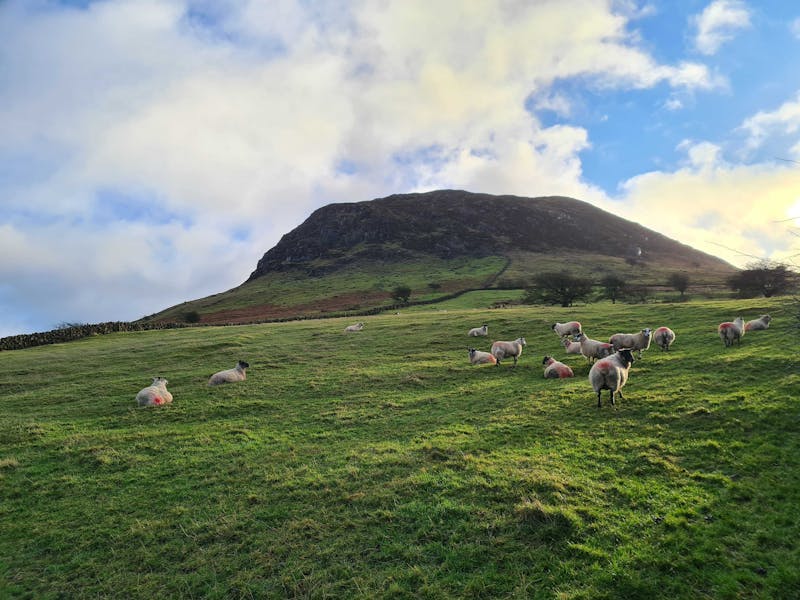
Stunning Slemish Mountain in Co. Armagh, which is really more of a hill. One of the sites linked with St. Patrick in his days as young slave forced to herd sheep for his captors.
Yet by 1070 AD, Ireland’s reputation in Europe had completely changed. In German historical documents, it was referred to as the somewhat mythical-sounding “Island of Saints”—the Insula Sanctorum. So what happened?

An image of Folio 27v from the 1200 year old Book of Kells
The story goes that as the rest of Europe was falling into the “Dark Ages”, Ireland continued to prosper and evolve as an island on the edge of the known world. Early medieval Ireland saw a Golden Age of education, art, literature, and culture centered around its many, many monasteries. We have the creation of spectacular illuminated manuscripts like the Book of Kells and the Ardagh Chalice, many impressive high stone crosses, and of course, Irish saints like St. Patrick becoming legendary.
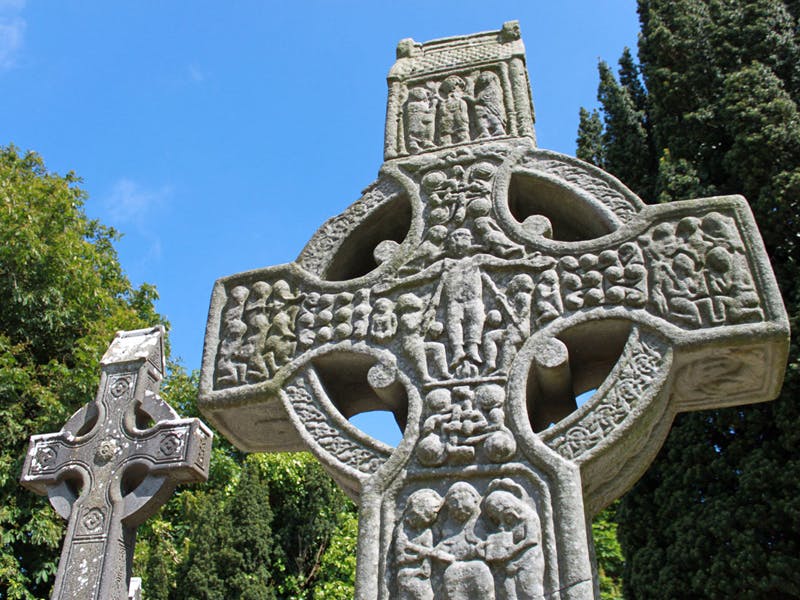
The The Muiredach Cross, erected to its impressive 19 ft or 5.8 m between 900 and 920 CE and believed by many to be the finest high stone cross in Ireland
Irish Saints
Who were these early Irish saints who were famous across Medieval Europe? Approximately 150 Saints’ Lives are known in Ireland—medieval manuscripts written to document the lives of people deemed worthy of elevation in the church. But if you include the numerous Irish saints our small island “exported” around Europe, that number gets closer to 400!

Patrick is a rare instance where we have an account written by the saint themselves. There are 8 known copies of his Confessio, this one from 8th century Book of Armagh. Patrick certainly knew how to hook a reader, written in Latin “I am Patricius, a sinner, a simple country person, the least of all believers and looked down upon by many.”
Photo Credit: © Board of Trinity College Dublin
Who are Ireland’s three Patron Saints: Patrick, Brigid and ..?
We all know who Patrick is, and many friends of My Irish Jeweler will also know who Brigid is as we tend to go on about her a bit! We make no apologies for that. In her day, she was one of the most famous women in Europe, and we are fans!

My visit to St. Brigid’s Well in Co. Kildare.
Photo Credit: My Irish Jeweler
.... Columcille a.k.a. Columba
Ireland’s third patron doesn’t get nearly as much press, so he’s the one we will focus on here. We really can’t see why he’s still in the shadow of Patrick and Brigid, given that his story has it all! Known in Ireland as Colmcille and in Scotland as Columba, he reportedly banished the Loch Ness monster… Perhaps that’s why no one can find it? More on that shortly.

Loch Ness in Scotland, home to the "water beast" banished to the depths by Columcille/Columba.
Photo Credit: Public Domain
Born around 521 AD in what is now Co. Donegal, Columcille came from well-connected stock. He’s claimed to be the great-great-grandson of Niall of the Nine Hostages, an Irish High King.
His younger years were spent near what is now called Glencolmcille, after the famous saint. He reportedly heard the call to the church young and was a gifted monk, travelling and working at some of the most famous monasteries in Ireland, including with St. Mobhí here in Dublin. He rapidly rose to become a priest and then an abbott, founding countless churches and several monasteries, including Durrow in County Offaly, Kells in Co. Meath, and Drumcliff in Co. Sligo. He is also the founder of my hometown of Swords in Dublin! Perhaps that’s why I have a soft spot for him?
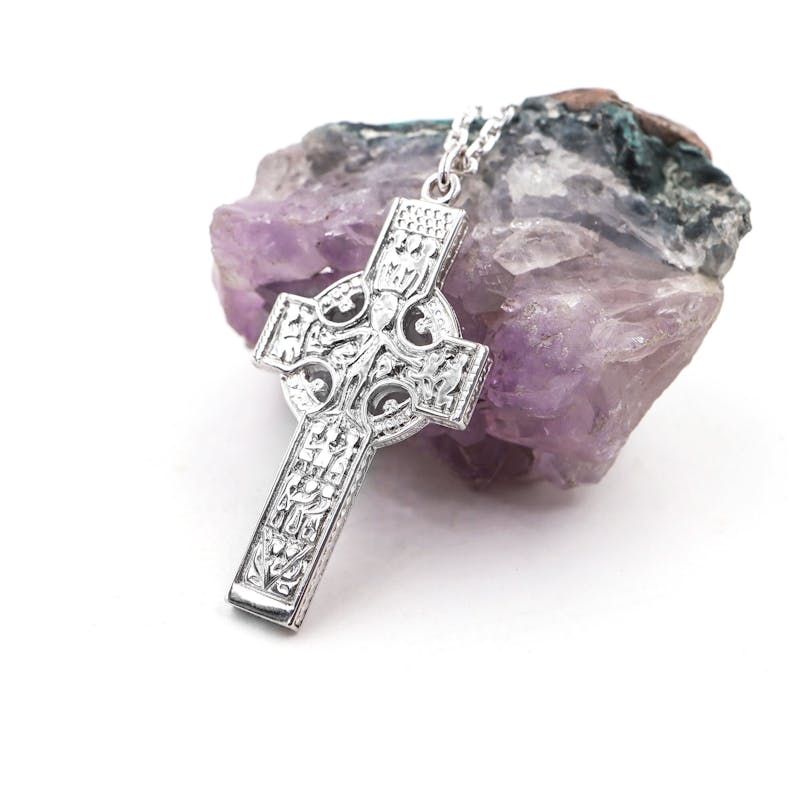
Collumcille's monastery in Durrow later went on to produce spectacular works like the Book of Durrow (100 years older than the Book of Kells) and an intricately carved high stone cross which still stands to this day.
Sometime around 560 AD, a now middle-aged Columcille got into a disagreement. Some say over the ownership of a manuscript he had created; others say over the protection of a prince wanted for manslaughter! Either way, he angered several well-connected people in Ireland, and depending on the sources, he either exiled himself or was banished to Scotland as a result. This might have been the end of his story, but he certainly didn’t rest on his laurels.

There's a marker at Stroove Beach on the Inishowen Peninsula in Co. Donegal commemorating the place where the banished or exiled saint set sail for Scotland.
Photo Credit: Janek Kloss (CC BY-NC 2.0)
Columcille, known as Columba in Scotland, rapidly began converting the native Picts to Christianity, acting as a diplomat between the local tribes, and founding monasteries and churches up and down the western coast, most famously at Iona.
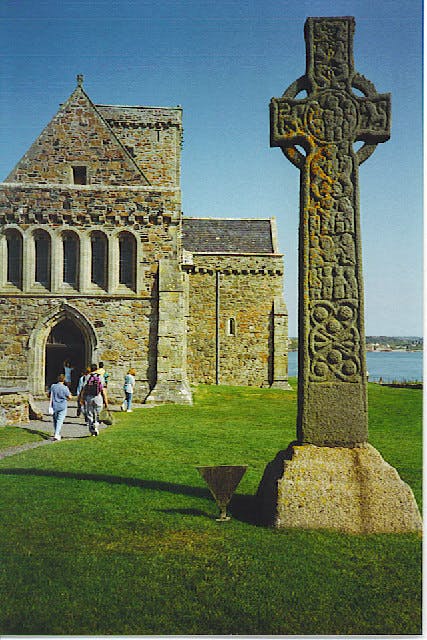
The spectacular monastic site at Iona was founded by St. Columcille or Columba in 563, famous as the birthplace of the Book of Kells and home to stunning high stone Celtic crosses.
Photo Credit: Colin Smith (CC BY-SA 2.0)
Despite all these achievements, the saint is perhaps best known, amongst Scottish and Irish schoolkids at least, because of his encounter with the "water beast" of Loch Ness. Recorded in St. Adamnan's 7th-century biography, The Life of Saint Columba, it's the first written account of the Loch Ness Monster! It seems Nessie really is ancient!
The story goes that the monster killed a local Pict and then tried to attack Columba's disciple, Lugne. Columba banished the beast to the depths of Loch Ness. He died an old man some time in the 590s surrounded by his monks on Iona, and his relics were later shared between Ireland and Scotland.

A mural in the Scottish National Portrait Gallery by William Hole (1846–1917)
Photo Credit: Photographer Kim Traynor (CC BY-SA 3.0)
Despite not having a national holiday here in Ireland, his legacy lives on with his feast day on June 9th each year. This day has been designated as International Celtic Art Day thanks to the saint's association with so many breathtaking pieces of Celtic art, including The Book of Kells and the Book of Durrow, as well as a great many high stone crosses.
More to discover
Irish history abounds with stories of our plentiful saints, including St. Ciarán, founder of Clonmacnoise, and St. Gobnait, who set her bees on raiders! So we think you will agree the title of the Isle of Saints is well deserved.
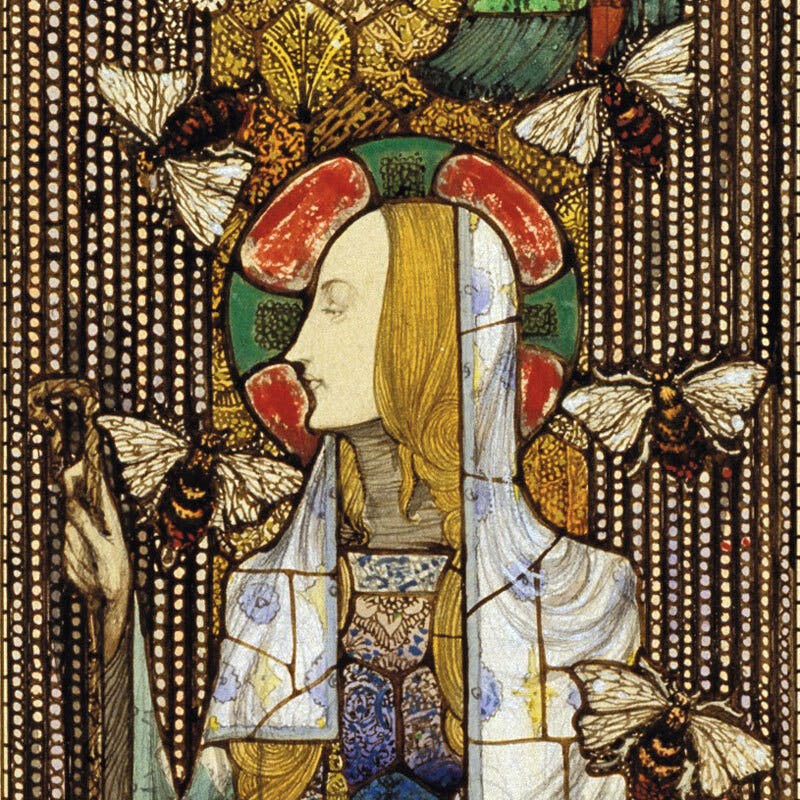
Harry Clarke's design for the Saint Gobnait window, Honan Chapel, Cork (1914).
Photo Credit: Public Domain
What's Next?
Check back in with us tomorrow for Day 8 of our St. Patrick's Day countdown, or open Door Number 7 of our 17 Days of celebratory offers!
Island of Saints
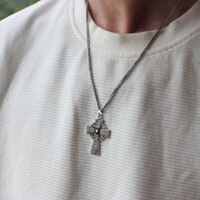
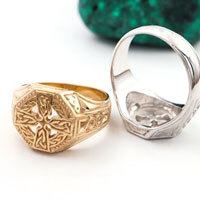
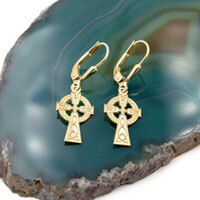
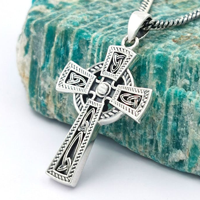
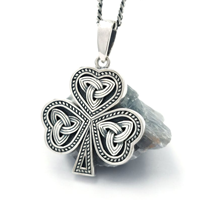
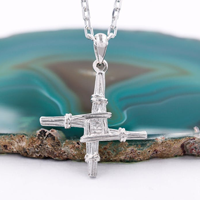
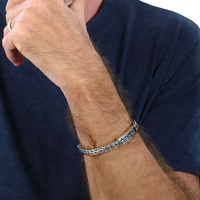
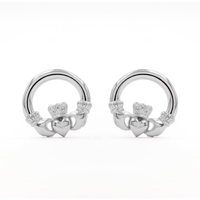
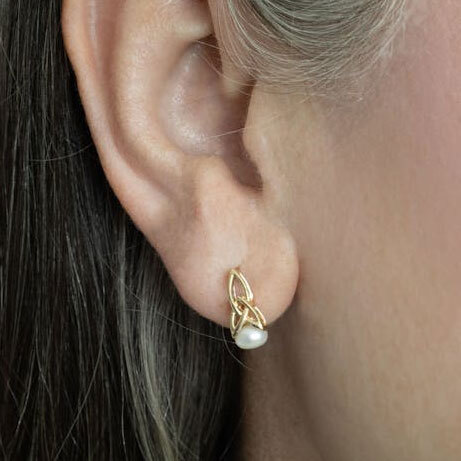
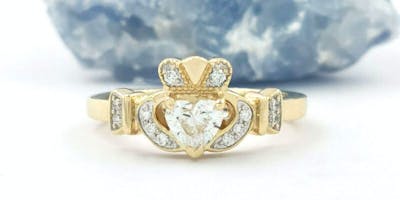
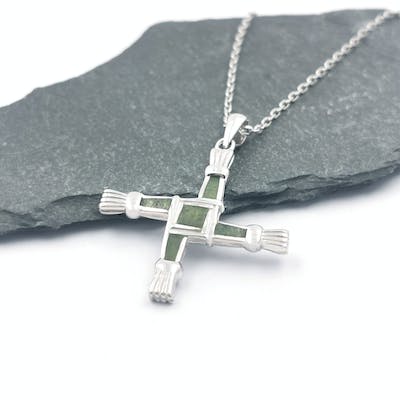
There are many choices for those that would like a piece of jewelry inspired by Ireland's patrons Patrick, Brigid or Columcille. Stunning replica high stone crosses or Book of Kells pieces for Columcille, the lovely Brigid's cross, or a simple St. Patrick's Cross.
Get In Touch
Have a question or something you're not entirely sure about when browsing our pieces? Please reach out. You can send us a note or give us a call—the Dublin workshop is here to make sure that you have a perfect experience from start to finish with My Irish Jeweler.
Follow us on Facebook and Instagram, to see what's new and upcoming. Join our Email list for early offers and special features.

Ciaran
My Irish Jeweler
Born in Co. Antrim and reared in Dublin, I was fascinated with Gaelic culture from an early age. I suppose it's not surprising given my mother inherited a grá for the Irish language from my grandfather, an Irish school headmaster. And that grá continues! My brother and sister are now Gaelic teachers here in Ireland, my niece is an award winning Irish dancer, and I proudly work to share Irish culture through our Irish and Celtic Jewelry at My Irish Jeweler!
I love researching and reading about the history of Irish design. It's at the core of what we do here at My Irish Jeweler. I find much of it so interesting that I have to share what I find. I hope you enjoy it!
Comments



 Ask Gemma