


When Does Spring Start in Ireland?
Written by Ciaran on Jan. 27, 2026 | 0 Comments
Ireland can be a confusing place, even for those who have lived here for years! We drive on the left, people make fun of you if they like you, and the phrase “I’m grand” can have a myriad of meanings, from deep contentment through to barely-contained rage. Visitors to our island should also note that an offer of hospitality should almost always be turned down at least once before accepting, just to be polite!
Another thing that seems to cause great confusion is our seasons. It is true that you can expect four seasons in one day, but it is the start of spring that seems to cause real consternation.

A handy reminder in Dublin Airport hopefully helps with clearing up any confusion for visiting motorists!
Photo Credit: Generalmiaow (CC-SA-4.0)
The start of spring in February?
You see we do things a little differently here in Ireland - many here count February 1st as the start of spring. Yes, you read that right … be it sunshine, snow, or sodden-sideways rain, February heralds spring here in Ireland. We’ve responded to more incredulous questions about this than almost anything else from folks across the globe. We suppose it's hardly surprising given the incredible winter storms hitting many parts of the Northern Hemisphere of late.
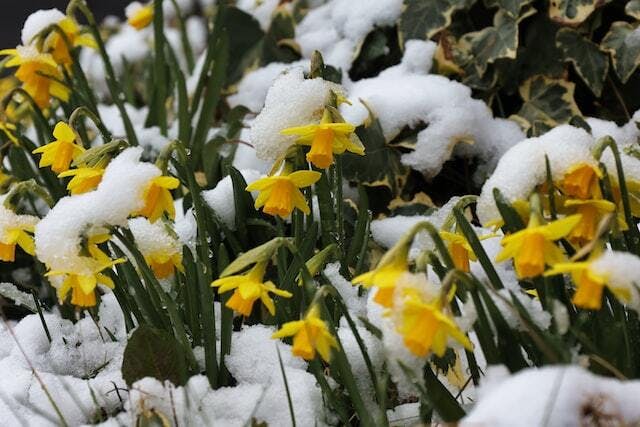
Photo Credit: Jack Blueberry on Unplash
Ways of marking the seasons
Spring in February? Madness! How can that be? Part of the explanation is that here in Ireland we have not one, or two, but three ways of marking the seasons.
Astronomical Spring starts March 20th
Of course, we observe the astronomical start of spring at the vernal equinox, the same as the rest of the Northern Hemisphere! This puts the start of spring around March 20th, the date at which the hours of sunlight in any given day start to outnumber the hours of darkness.
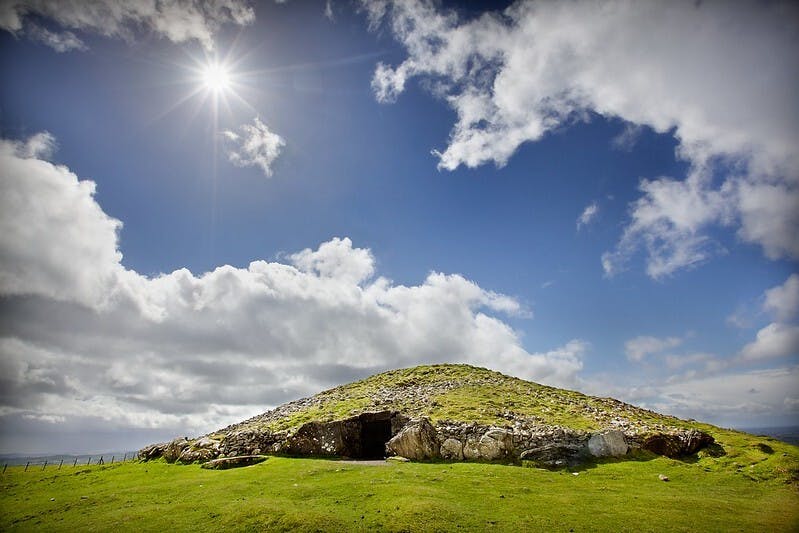
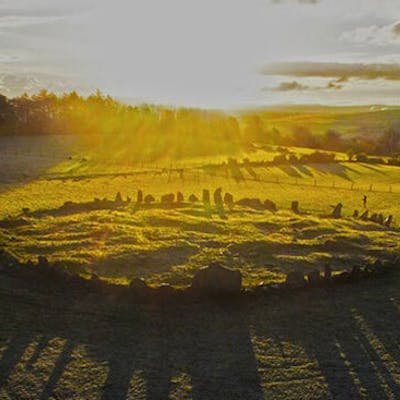
Cairn T at Loughcrew in Co. Meath is over 5000 years old and is built in alignment with the rising sun on the Equinox.
Photo Credit: Michael Foley (CC BY-NC-ND 2.0)
The equinox is certainly an important time of year here in Ireland, with stone monuments over 5000 years old attesting to that fact .These magnificent structures were built in alignment with the sun on the equinox. But ask your average Irish person when spring starts, and it would be very unlikely for them to say March 20th.
Meteorological Spring starts March 1st
Meteorological seasons divide the year up according to average temperatures. The hottest three months are summer, the coldest three are winter, with spring and autumn slotting in between. Since Ireland's warmest months are June, July and August, this puts the start of spring in Ireland at March 1st. But again, most Irish people you ask wont say March 1st for the start of spring either.

I saw the first daffodils of the season in January this year. They really get going in February and can be spotted lining hedgerows, gardens, and roads throughout the country by March and into April - pictured here in my local park last February.
Photo Credit: C. Vipond
Traditional Spring starts February 1st
Many here in Ireland go by the old Celtic or Gaelic tradition, that puts the start of spring on February 1st, Imbolc, or St. Brigid’s Day. The daffodils have it right!

This in an entry in the National Folklore Collection from 1938 - a piece of writing by an Irish schoolchild, appropriately named Brigid, talking about the start of spring in February.
You see, before Christianity in Ireland, the year was divided up by four key festivals. Bealtaine on May 1st, Lughnasa on August 1st, Samhain on October 31st, and Imbolc on February 1st.
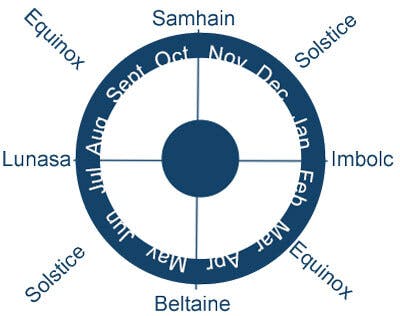
The year in the Gaelic or Celtic Calendar, divided up into quarters by the four main festivals
The first recorded mention of Imbolc and it being the start of spring is found in Tochmarc Emire, The wooing of Emer. This tale in the Ulster Cycle thought to date back to as early as the 6th to 8th century. In it, Emer, challenges her would-be husband to prove his worth, by tasking Cú Chulainn to stay awake
"from Samain (Samhain), when the summer goes to its rest, until Imbolc, when the ewes are milked at spring’s beginning, and from Imbolc to Beltine (Beltane) at the summer’s beginning, and from Beltine to Bron Trogain, earth’s sorrowing autumn.”

The legendary meeting of Emer and Cu Cullain is said to be set around the 1st century. Many take elements of this story, including the calendar, to reflect the conditions of early medieval Ireland.
Halfway between the winter solstice and the spring equinox, the festival of Imbolc, which roughly translates as "in the belly" in old Irish, marked the “death” of winter and the "birth" of spring. This festival was marked by feasts and bonfires to honor the Goddess Brigid, in the hopes that the coming growing season would be fruitful.
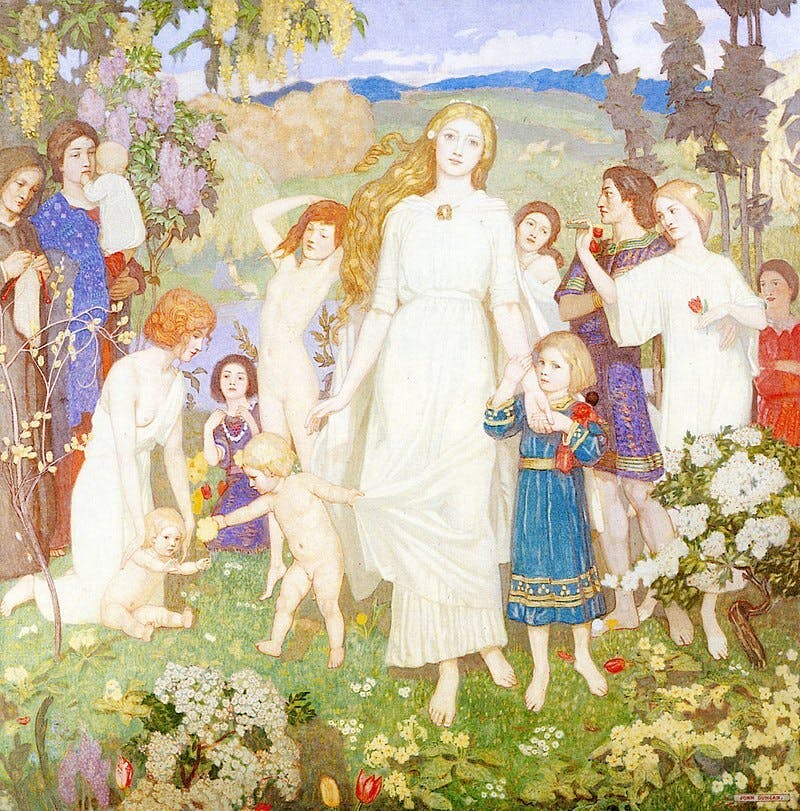
The Coming of Bride, a painting of the Goddess Brigid or Bride, by John Duncan (1917).
Photo Credit: Public Domain
As a society entirely reliant on the land, the seasons were a matter of life and death. The seasons gave our ancestors an indication of when to sow and harvest. The first flowers were blooming, buds were on trees, days lengthened, and birds returned and their songs filled the forest. And after the dark and quiet of winter, the fire and light of Imbolc was a celebration of new life and new beginnings, and of hope, possibility and growth on the horizon. Who wouldn’t want to get that started as quickly as possible?
So when is spring REALLY?
Officially, the Irish Meteorological Service sits firmly on the fence, and considers that each system is correct. This may be a little unsatisfactory for those that like definitive answers, but like many things in Ireland, seasons are complicated! Whether Traditional, Astronomical, or Meteorological, each of the approaches serves a purpose and gives us valuable information about the keenly awaited onset of spring.
Get In Touch
Have a question or something you're not entirely sure about when browsing our pieces? Please reach out. You can send us a note or give us a call—the Dublin workshop is here to make sure that you have a perfect experience from start to finish with My Irish Jeweler.
Follow us on Facebook and Instagram, to see what's new and upcoming. Join our Email list for early offers and special features.

Ciaran
My Irish Jeweler
Born in Co. Antrim and reared in Dublin, I was fascinated with Gaelic culture from an early age. I suppose it's not surprising given my mother inherited a grá for the Irish language from my grandfather, an Irish school headmaster. And that grá continues! My brother and sister are now Gaelic teachers here in Ireland, my niece is an award winning Irish dancer, and I proudly work to share Irish culture through our Irish and Celtic Jewelry at My Irish Jeweler!
I love researching and reading about the history of Irish design. It's at the core of what we do here at My Irish Jeweler. I find much of it so interesting that I have to share what I find. I hope you enjoy it!
Comments




 Ask Gemma