St. Brigid was once one of the most famous and beloved saints in Ireland and Europe with both national and international acclaim. Some have dismissed her as a repackaging of an older Celtic goddess who shared the name, but she’s now celebrated with her own national holiday, matching her fellow Irish patron saint, Patrick. Clearly there is not a simple answer to the question “Who was St. Brigid?” Read on to discover nine different faces of this enigmatic and beloved figure.

A Brigid mural in Co. Louth showing her Celtic and Christian faces as one. Created as part of the SEEK Visual Arts Festival in August 2020 by the talented artist Friz.
Brigid the Slave
Starting at the very beginning, it might surprise some to hear that this saint may have been born a slave. It is widely agreed that Brigid was born in the middle of the 5th century, around 451 or 452 AD, in Leinster, some believe near Faughart, in County Louth, while there is more historical evidence to say she was always a Kildare woman, born in the Fothairt dynasty. There is also plenty of agreement that she was the daughter of a Leinster chieftain, a sort of low key king, named Dubhthach and a possibly enslaved Christian woman named Broicsech. In some records, her mother was said to be baptised by none other than Saint Patrick himself, though this quite possibly gilding the lily!

St. Brigid's Shrine and Holy Well, Hill of Faughart, Co. Louth
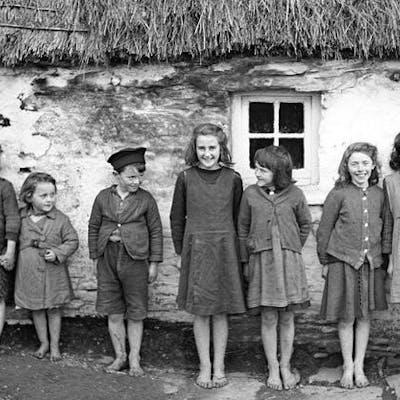
Given her position, Brigid’s early years were most likely spent working alongside her mother, tending to livestock, milking cows, churning butter, and tending the harvest.
Brigid the Miracle Worker
One of the primary records of her life tells her story through a succession of 32 miracles. It seems even as a child, Brigid had a knack for working miracles. In one of her earliest, she is recorded as giving away her mother's entire stock of butter to a poor and hungry man. The store was then replenished with some to spare in answer to a young Brigid's prayers, a tale which later made her the patron saint of milkmaids.

A woman, possibly St Brigid, milking a cow.
She is credited with restoring sight to the blind, hearing to the deaf, being able to hang her possibly quite magical cloak on a sunbeam - more on her cloak later - and in a very memorable entry, she also turned water into beer, gaining her the patronage of brewers.
Brigid the Disciple
Given the patriarchal set up of Ireland in her day, Brigid most likely worked for her father, but it seems she had a habit of giving away his possessions to the needy as well. This didn't sit well with her father, and he and Brigid's bothers planned to marry her off and be rid of her. In one story, she plucked out her eye, hoping this would spare her from married life!
Growing frustrated by her antics, Brigid’s father brought her to the local King to sell her off as a slave and be rid of her for good. The Christian king recognized her goodness and charity and decreed that Brigid should be freed from the responsibilities of marriage as well as the fate of a slave:
“for her merit before God is greater than ours.”
And with that pronouncement, Brigid was free to follow her faith, training to become a nun and, in some records, a disciple of St. Patrick.

The ancient Book of Armagh holds that "'Between Saint Patrick and Saint Brigid, the pillars of the Irish people, there was so great a friendship of charity that they had but one heart and one mind." Given the dates involved, Brigid was only a child of 10 or 11 when Patrick died, so it's unlikely that they were literally friends. It could be read to mean that they both valued charity and were working to the same goal.
Brigid the Bishop?
Now free, Brigid pursued her calling. She was all set to "take the veil" but in one record, she somehow emerged from the ceremony a Bishop. While some sources deem Brigid’s ordination accidental, others recount that Brigid was indeed intentionally ordained a bishop by Mél, in some tellings, a nephew of St. Patrick. In some versions this was chalked down to his drunkenness, but in another Mél was reportedly only
“intoxicated with the grace of God.”

A depiction of St. Brigid recieving a Bishop's crozier from Mél, in a stained glass window in St. Patrick's Cathedral Armagh.
The event is described in the Book of Lismore, written many centuries later in the 1400s:
“It came to pass then, through the grace of the Holy Ghost, that the form of ordaining a Bishop was read out over Brigit. Mac-caille said that a bishop’s order should not be conferred on a woman. Said Bishop Mél: No power have I in this matter. That dignity hath been given by God unto Brigit, beyond every (other) woman. Wherefore the men of Ireland from that time to this give episcopal honour to Brigit’s successor.”
Whatever the reason, the outcome remains that Brigid became a very powerful leader, and this power became a legacy which passed to her successors who headed up her Monastery in Kildare for centuries to come.
Brigid the Negotiator
With her new office, Brigid needed a centre of learning and faith, a monastery. Brigid looked to the King of Leinster for land after finding a perfect place for her convent beside an oak forest. The King refused but with a prayer from Brigid, God reportedly softened his heart (and perhaps his mind?).
Brigid then asked for all the land her cloak would cover. The king agreed, thinking he was going to get away very lightly. Like a flash, four of Brigid’s nuns took up the corners of her cloak and ran swiftly to the points of the compass, spreading it out to cover a vast tract of land. Terrified, the king agreed to give Brigid a “decent plot of ground" and it was this site where she established “Cill Dara,” the Church of the Oak.

Though Brigid's original church of the oak is no more, a church bearing her name still stands in Kildare as well a statue depicting her at "her" holy well.
Photo Credit: My Irish Jeweler
Brigid the Collaborator
Brigid was intent on building a great community at Kildare. Records say she invited a hermit, a talented metalsmith and manuscript maker, called Conleth to help her in Kildare as a spiritual leader.
One biographer reports that Brigid chose Saint Conleth "to govern the church along with herself." It seems this arrangement of two leaders, Brigid and Conleth, was an excellent working partnership as they
“... governed their primatial Church by means of a mutually happy alliance and by the rudder of all the virtues. By the merits of both, their episcopal and conventual see spread on all sides like a fruitful vine with its growing branches and struck root in the whole island of Ireland.”

A statue Of St. Conleth, Brigid's co-Bishop at Kildare
With their efforts, Kildare grew to become a great centre of learning, a place of pilgrimage, refuge, and safety at its height from the 7th to 9th century.
Brigid the Protector
Though there are many fantastical elements to many of the miracles attributed to Brigid, most are acts to protect and help the poor and needy, like the story of Brigid and the brooch. In Brigid’s day, the great and the good showed their rank and power through jewellery, like ornate brooches. These were very important and valuable pieces indeed.

The sterling silver Ballyspellan Brooch with names (possibly of owners) engraved on the back in ogham.
Photo Credit: National Museum of Ireland
A nobleman had accused a woman of stealing a silver brooch which he had entrusted to her for safekeeping. The man had secretly thrown this brooch into the sea, expecting that the woman would be granted to him as a slave if a Brehon (judge) ruled in his favour on the matter. The accused woman sought refuge with Brigid and miracle of miracles, Brigid found the “stolen” brooch in the belly of a fish caught by a local fisherman. The nobleman confessed his sin on the spot, dropped the accusation, and bowed in submission to Brigid.
St. Brigid the icon
St. Brigid owes her legacy in part to a monk from the monastery at Kildare by the name of Cogitosus. Cogitosus wrote the oldest record of the life of Saint Brigid, the Vita Sanctae Brigidae, around 650. Written nearly 100 years after her death, this record proved to be incredibly popular and was copied and shared amongst monasteries in Ireland and across Europe, with stories of Brigid’s exploits reaching far and wide, making her internationally famous for many centuries after her death.

A fresco of "The Blessings of St. Brigid" from 1524 by the artist Lorenzo Lotto in the Suardi Chapel in Bergamo, Italy.
It seems her story caught the hearts and minds of people around Ireland and indeed Europe, with churches and wells named in her honor. People today still make and display Brigid’s cross worldwide as a symbol of that saint and her protection.

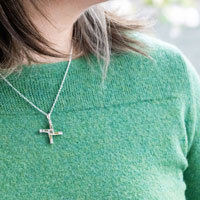
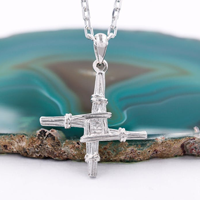
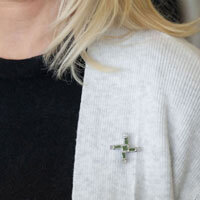
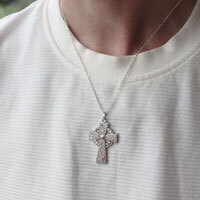
The Brigid's cross is a symbol of protection that many in Ireland wear year round, and especially on Brigid's Day.
Photo Credit: My Irish Jeweler
Brigid the Myth?
With all that you may be wondering why there is any controversy over the existence of St. Brigid at all? The idea that St. Brigid was a Christian repackaging of a pagan goddess is a relatively new one that seems to have really taken hold during the Victorian era and the Celtic Revival at the end of the 19th century.
Perhaps this mural is something closer to the truth. There was both a goddess AND a saint that shared the same name. And with time and retelling, the two mixed and mingled into a beloved and celebrated figure that can't now be divided?
Photo Credit: D. Sexton (CC BY-SA 4.0)
It is true that there was quite a lot of repackaging of Celtic tales by Christian monks in the early days of the church in Ireland. Many tales surrounding Irish saints, including the iconic St. Patrick, involve more than a sprinkling of fantastical Celtic mythologizing. Patrick reportedly could turn himself into a deer, for example! Though there may have been some intermingling of stories, historians agree that just like her fellow patron saint, Patrick, Brigid of Kildare is undoubtedly more than a myth and deserves her spot as a beloved Irish icon.
What do you think?
We are big fans of Brigid, the saint and the goddess, here at My Irish Jeweler, and we always love to hear from folks who share our curiosity about Ireland’s distant past. Do you take the side of the Celtic Goddess, or are you happy with the historians' assessment? Drop us a comment below! For those keen to learn further, we wholeheartedly recommend this podcast for those looking to discover more about Ireland’s female patron saint.









 Ask Gemma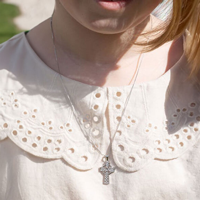














I loved the information. I'm using it for an essay in school about a Saint. I couldn't find what she is the patron saint of, so I searched it up: Milking cows, midwives, Ireland, and milk. When she was a kid, she milked cows and helped sell the milk.